TB-500: units to draw, weekly schedule and what's still active
TB-500 is a synthetic fragment of thymosin beta-4, researched for tissue repair, angiogenesis and inflammation modulation. The Peppy catalog lists it as a reconstituted vial dosed in mg, typically weekly, with a half-life of about 60 hours. Peppy converts vial, water and mg into syringe units, keeps the weekly schedule and shows an estimate of what is still active.
Looking for the medication page? See the TB-500 tracker for iPhone: units to draw, weekly shots, cycles and what's still active.
TB-500 reconstitution calculator
TB-500 reconstitution calculator
Free in the appHow long TB-500 stays active
Active in your system — TB-500
estimate for weekly doses, half-life 60 hAn estimate from the half-life, not a measurement. Individual clearance varies. Peppy shows this curve for each protocol under Active in your system.
TB-500 dose steps in the catalog
| TB-500 — catalog dose ladder | Dose |
|---|---|
| Step 1 | 2 mg |
| Step 2 | 2.5 mg |
| Step 3 | 5 mg |
Dose steps as listed in the Peppy catalog so the picker is fast — not a recommendation. Your prescriber sets your dose; Peppy tracks it.
Tracking TB-500: what matters
TB-500 is dosed in whole milligrams, which makes the syringe math feel easier than a mcg peptide until you change the water volume. A TB-500 reconstitution calculator keeps it honest: a 5 mg vial with 1 mL of water is 5 mg/mL, so 2 mg is 40 units and 2.5 mg is 50 units. Add 2 mL instead and 2 mg becomes 80 units, which is most of a 1 mL syringe. Peppy shows the units on the protocol card and in the Log shot sheet, and warns when a dose will not fit a single 1 mL draw.
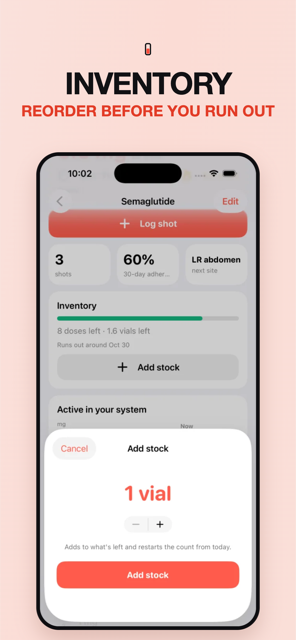
Because the doses are large relative to the vial, a 5 mg vial can be as little as two shots. Inventory (Pro) turns vials times doses per vial into "≈ 4 doses left, runs out around Oct 3" and sends a running-low alert, so a weekly protocol does not stall waiting for a delivery. The vial inventory guide covers how partial vials are counted.
TB-500 is one of the most common companions to BPC-157. If you log both, they are separate protocols in Peppy with separate colors; the body map rotates sites across the pair so a Monday TB-500 shot and a Tuesday BPC-157 shot do not land on the same spot. The stack tracker guide shows the setup.
Schedule and cycles
The Peppy catalog lists TB-500 as weekly, with a dose ladder of 2, 2.5 and 5 mg (catalog listing, not a recommendation). Two patterns show up in what people track: a steady weekly shot, and a front-loaded block with more frequent shots followed by a weekly maintenance phase. Peppy models the second with dose step-ups (Pro), where each rung has a duration and the card, reminder and log sheet advance automatically. Cycles (Pro) handle a defined off period. Your prescriber decides the pattern; Peppy keeps it on the calendar.
With a listed half-life of about 60 hours, the "active in your system" curve is still visible several days after a shot, so the weekly chart looks very different from a short-acting peptide. It is an estimate from the catalog number, not a measurement.
How to do this in Peppy
- In Protocols, tap + and search "TB-500" (or "thymosin"). Form, unit and weekly frequency come from the catalog.
- Enter your dose in mg. Open the inline Calculator, type the vial size and water volume, and note the units Peppy shows. Adjust the water if the draw is close to the 1 mL limit.
- Pick the weekday and time. If you run a loading phase, add rungs under Dose step-ups (Pro) with a duration for each.
- Under Inventory (Pro), enter your vials and doses per vial for the running-low alert.
- On shot day, tap the countdown on Today, pick the suggested site on the body map and log. Edit a past log from the Calendar if you got the time wrong.
- Check Progress (Pro insights) for the active-level curve next to your check-in notes.
The TB-500 tracker page has the week-by-week view.

Track it in Peppy
123 compounds built in, the units math done for you, body-map site rotation and reminders — private on your iPhone.
 Free · iPhone · no account
Frequently asked
How many units is 2 mg of TB-500?
Example: a 5 mg vial mixed with 1 mL of bacteriostatic water is 5 mg per mL, so 2 mg is 0.4 mL, or 40 units on a U-100 syringe. With 2 mL of water it is 80 units. A 2.5 mg dose from the same 1 mL mix is 50 units. Run your own numbers in Peppy's calculator and verify with your prescriber.
How often is TB-500 typically scheduled?
The Peppy catalog lists TB-500 as a weekly shot. Some people log a higher-frequency loading block followed by a weekly maintenance block; Peppy's dose step-ups (Pro) can model a schedule like that. Whether either pattern fits you is a question for your prescriber.
What is TB-500's half-life?
The Peppy catalog lists roughly 60 hours (2.5 days), which is what the "active in your system" chart uses. It is an estimate for timing purposes, not a measured level.
Where do you inject TB-500?
Most people log subcutaneous sites: abdomen, thighs, upper arms. Weekly shots make rotation easy to forget, so Peppy's body map records the site and suggests the next one. See the rotation guide.
Can I track BPC-157 and TB-500 together?
Yes. Each is its own protocol with its own color, schedule and vial. Peppy rotates injection sites across both and shows them together on the Today tab and calendar. Running more than one active protocol is a Pro feature.
How many units is 2.5 mg of TB-500?
It depends on how the vial was mixed. Example: a 10 mg vial plus 2 mL of bacteriostatic water is 5 mg/mL, so 2.5 mg is 0.5 mL, or 50 units on a U-100 insulin syringe. Change the water and the units change. Use the calculator above with your own vial, and verify with your prescriber.
How long does TB-500 stay in your system?
The Peppy catalog lists a half-life of about 2.5 days for TB-500. After roughly five half-lives, about 12.5 days, most of a single dose has cleared. That is an estimate from the half-life, not a measurement, and individual clearance varies.
Can I track TB-500 in Peppy?
Yes. TB-500 is one of 123 compounds built into Peppy, with its form, unit and typical frequency prefilled. Add it as a protocol, set your schedule, and Peppy handles the countdown, the log and the reminders (Pro).
Where should I inject TB-500?
Follow your prescriber's instructions. For subcutaneous shots the GLP-1 labels list the abdomen, thigh and upper arm and say to rotate. Peppy's body map has 13 sites, suggests the next one, and shows when each was last used. Read the site rotation guide.
More in Healing & recovery
Not medical advice. Peppy is a tracking tool, not medical advice. Dose calculations are mathematical conversions only. Always follow your prescriber's instructions and verify every draw-up yourself.