How many units to draw: the reconstitution math, worked out
Divide the vial's milligrams by the millilitres of water you added to get the concentration, then divide your dose by that concentration to get millilitres. On a U-100 insulin syringe, 1 unit is 0.01 mL, so multiply millilitres by 100. A 5 mg vial with 2 mL of water is 2.5 mg/mL; a 250 mcg dose is 0.1 mL, which is 10 units.
Why "how many units to draw" is the question everyone asks
A peptide vial arrives as a dry powder labelled in milligrams. Your prescriber or protocol gives you a dose in micrograms or milligrams. Your syringe is marked in units. None of those three speak the same language, and the piece that connects them is the amount of water you add when you reconstitute the vial. Get that step wrong and every draw after it is wrong too.
The good news is that the maths is three lines long, and once you have done it for a vial you write the answer on the vial and stop thinking about it. This guide walks through the formula, a table of worked examples, and how BPC-157 and other vial compounds are set up in Peppy so the app does the conversion for you.
What a U-100 syringe actually measures
An insulin syringe is marked in "units" because it was designed for U-100 insulin, which contains 100 units per millilitre. The unit is a volume, not an amount of drug: 1 unit = 0.01 mL, and 100 units fill a 1 mL syringe. Smaller syringes (0.3 mL and 0.5 mL) use the same scale; they just stop at 30 or 50 units.
That is why the "units" you draw for a peptide depend entirely on the concentration in your vial. The syringe is measuring liquid. How much peptide is in that liquid is set by you, once, when you add the water.
The formula
Three steps, in the same units throughout (convert mg to mcg or the other way before you start; 1 mg = 1,000 mcg):
- Concentration = vial amount ÷ water added. A 5 mg vial with 2 mL of water is 2.5 mg/mL, or 2,500 mcg/mL.
- Volume = dose ÷ concentration. 250 mcg ÷ 2,500 mcg/mL = 0.1 mL.
- Units = volume × 100. 0.1 mL × 100 = 10 units.
Collapsed into one line: units = (dose ÷ vial amount) × water mL × 100. For the example above: (250 ÷ 5,000) × 2 × 100 = 10.
Worked examples
Every row uses the same formula. The doses are illustrations of the arithmetic, not suggestions; the vial sizes and water volumes are the ones people most often ask about.
| Vial | Water added | Concentration | Dose | Volume | Units (U-100) |
|---|---|---|---|---|---|
| 5 mg | 2 mL | 2.5 mg/mL | 250 mcg | 0.10 mL | 10 |
| 5 mg | 1 mL | 5 mg/mL | 250 mcg | 0.05 mL | 5 |
| 5 mg | 2 mL | 2.5 mg/mL | 500 mcg | 0.20 mL | 20 |
| 10 mg | 2 mL | 5 mg/mL | 500 mcg | 0.10 mL | 10 |
| 2 mg | 2 mL | 1 mg/mL | 200 mcg | 0.20 mL | 20 |
| 5 mg | 1 mL | 5 mg/mL | 2.5 mg | 0.50 mL | 50 |
| 5 mg | 3 mL | 1.67 mg/mL | 2 mg | 1.20 mL | 120 — does not fit |
Notice the first two rows. Same vial, same dose, different water, different units. Halve the water and you halve the units. Notice the last row too: a 2 mg dose from a 5 mg vial diluted with 3 mL comes out at 120 units, more than a 1 mL syringe holds. That is the case a calculator should warn you about before you are standing there with a full syringe and a dose left over.
Common ways the maths goes wrong
- Mixing mg and mcg. A 5 mg vial is 5,000 mcg. If the dose is in mcg, convert the vial to mcg first.
- Forgetting how much water went in. Write the concentration on the vial the day you reconstitute it. Two weeks later you will not remember whether it was 1 mL or 2.
- Reading the syringe as mL when it is marked in units. 0.1 on a mL scale is 10 on a units scale. Check which scale your syringe prints.
- Assuming a dose "should" be a round number of units. 7 units is a perfectly valid draw. If a dose lands on a fraction of a unit, more water gives you a rounder number.
Pens like Wegovy, Ozempic, Mounjaro and Zepbound are pre-filled and dialled in milligrams, so none of this applies to them; the label sets the dose per click. The maths is for vials, whether that is a research compound like TB-500 or CJC-1295 / Ipamorelin, or a pharmacy-compounded GLP-1 that arrives as a multi-dose vial. Those have their own quirks, covered in compounded semaglutide and tirzepatide units.
Try it: the live calculator
This is the same calculator that ships in Peppy, prefilled for BPC-157. Change the vial, the water and the dose and watch the units update. Always verify with your prescriber.
BPC-157 reconstitution calculator
Free in the appHow to do this in Peppy
Peppy does the conversion once when you set up a protocol, then shows the answer every time a shot is due. The reconstitution calculator is free.
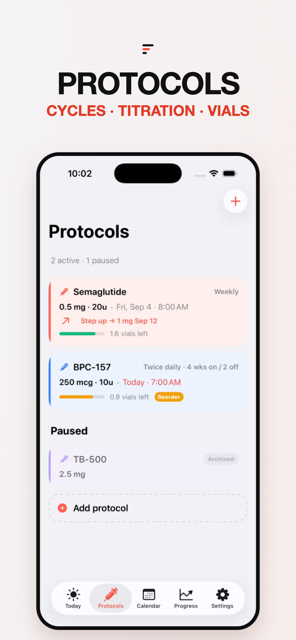
- Open the Protocols tab and tap +. Search the catalog for your compound (BPC-157, TB-500, CJC-1295/Ipamorelin and 79 other vial compounds are built in) or add a custom one. Peppy prefills the form, the unit and the typical frequency.
- In the editor, fill in the Reconstitution card: vial mg, water mL and your dose. Peppy shows "Draw up 10 units" underneath, updating as you type. If the volume is more than 100 units it warns you that the dose will not fit a 1 mL syringe.
- Save. From now on the protocol card on the Today tab, the reminder notification (Pro) and the Log shot sheet all show the units, so you never redo the maths on shot day.
- Need a one-off conversion for a vial that is not a protocol? Open Settings ▸ Calculator, the standalone version of the same tool. It is also on this site.
- If you change the water next time you reconstitute, edit the protocol's Reconstitution card and the units update everywhere. Pair it with inventory (Pro) and Peppy will also count the doses left in the vial.
Peppy is a tracking tool. Dose calculations are mathematical conversions only. Always follow your prescriber's instructions and verify every draw-up yourself.

Track it in Peppy
123 compounds built in, the units math done for you, body-map site rotation and reminders — private on your iPhone.
 Free · iPhone · no account
Frequently asked
How many units to draw for 250 mcg from a 5 mg vial?
It depends on how much water you added. With 2 mL of bacteriostatic water the vial is 2.5 mg/mL (2,500 mcg/mL), so 250 mcg is 0.1 mL, which is 10 units on a U-100 syringe. With 1 mL of water it would be 5 units. Always verify with your prescriber.
How many units are in 1 mL on an insulin syringe?
A U-100 insulin syringe has 100 units per millilitre, so 1 unit = 0.01 mL, 10 units = 0.1 mL and 50 units = 0.5 mL. The markings are the same whether the syringe holds 0.3, 0.5 or 1 mL; only the total capacity changes.
Does adding more water change the dose?
No. More water lowers the concentration, so you draw more units for the same dose, but the amount of peptide in the syringe is identical. People add more water when a dose would otherwise be too small to measure accurately on the syringe.
What if the number of units is more than 100?
Then the dose does not fit in a 1 mL syringe at that concentration. Peppy's calculator flags this. The usual fix is to reconstitute with less water so the concentration is higher, or to check the numbers with your prescriber. Never take two draws without checking.
Is a peptide calculator the same as a dosing recommendation?
No. A reconstitution calculator is a unit converter: it turns a dose you already have into a volume on a syringe. It does not tell you what dose to take. Peppy is a tracking tool, and every dose calculation in it is a mathematical conversion only.
Sources
Not medical advice. Peppy is a tracking tool, not medical advice. Dose calculations are mathematical conversions only. Always follow your prescriber's instructions and verify every draw-up yourself.