Injection site rotation: where to inject next, and how to keep track
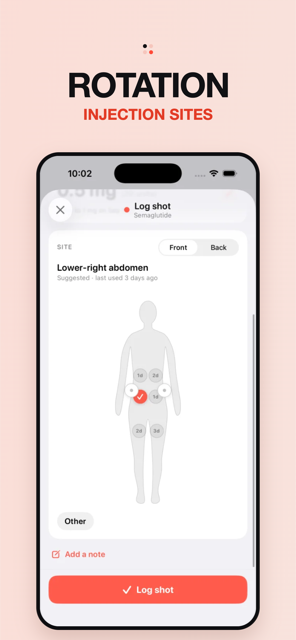
The Wegovy, Ozempic, Mounjaro and Zepbound labels all list the same three regions for a subcutaneous shot: abdomen, thigh and upper arm, and all say to rotate. Rotation means not landing in the same spot twice in a row. The simplest system is a fixed order across sites, and a log of which one you used last, which is what Peppy's body map does.
What the labels say about injection site rotation
You do not have to guess where a GLP-1 shot is allowed to go. Each label lists it in the dosing section, and the wording is nearly identical across brands:
- Wegovy: "Inject subcutaneously in the abdomen, thigh, or upper arm. The time of day and the injection site can be changed without dose adjustment."
- Ozempic: same three regions, plus "use a different injection site each week when injecting in the same body region."
- Mounjaro and Zepbound: "abdomen, thigh, or another person should inject in the back of the upper arm. Rotate injection sites with each dose."
- Saxenda: same three regions; "rotate injection sites within the same region in order to reduce the risk of cutaneous amyloidosis."
Research peptides such as BPC-157 or compounded Compounded Semaglutide in a vial have no label to quote, but they are also subcutaneous shots, and the people who use them tend to borrow the same three regions and the same rotation habit.
Why rotate at all
The clearest evidence comes from insulin, where people have been giving themselves daily subcutaneous shots for decades. The 2016 injection-technique recommendations published in Mayo Clinic Proceedings report that roughly a third of insulin users have lipohypertrophy, thickened or lumpy fat tissue at the injection site, and tie it to incorrect site rotation. Injecting into those areas makes absorption blunted and variable. The recommendations' fix is simple: rotate correctly, keep a finger-width between recent shots, and never inject into a lump, a bruise or scar tissue.
Weekly GLP-1 shots are less frequent than insulin, but the same tissue is involved, and most people on them stay on them for months. Many people also report that a spot that gets hit repeatedly is the one that bruises or stays sore. Rotation is a cheap habit that removes the problem before it starts. If you do see a persistent lump or an injection site reaction, that is a conversation for your prescriber.
A rotation system that survives real life
The labels tell you to rotate. They do not tell you how, and "somewhere different" falls apart by week six when you cannot remember whether last time was left or right. What works is a fixed order that you never have to think about, and a record of where you were in it.
A common pattern is to split each region into left and right and cycle through them, for example: lower-left abdomen, lower-right abdomen, left thigh, right thigh, back to the abdomen. A weekly shot then takes a month to return to the same site. Daily peptide shots move through the order faster, which is where the record matters more than the order.
Peppy tracks 13 sites, listed below. The abdomen is split into four quadrants because it is the region most people use and the one that needs the most spacing.
Front of the body map
- Upper-left abdomenUL abdomen
- Upper-right abdomenUR abdomen
- Lower-left abdomenLL abdomen
- Lower-right abdomenLR abdomen
- Left flankL flank
- Right flankR flank
- Left thighL thigh
- Right thighR thigh
- OtherOther
Back of the body map
- Left upper armL arm
- Right upper armR arm
- Left gluteL glute
- Right gluteR glute
Rotating across more than one compound
If you take a weekly GLP-1 and a daily peptide, or run a stack of several peptides, rotation per protocol is not enough. Two protocols each on their own rotation can still land on the same thigh on the same morning. The rotation has to be shared: one order, one "last used" record, across everything you inject. That is a spreadsheet headache and one of the main reasons people move to an app (see spreadsheet vs app).
How to do this in Peppy
Site rotation is free in Peppy and works for every protocol, from a weekly Zepbound pen to a twice-daily peptide.
- When a shot is due, open the Today tab and tap the protocol's Log button. The Log shot sheet opens with a front-and-back body silhouette.
- Peppy marks the site it suggests next and shows when each site was last used, for example "Left thigh · last used 6 days ago". The suggestion follows your rotation order and is shared across all of your protocols, so two compounds never collide on one site.
- Tap the site you actually used. You can pick a different one from the suggestion; Peppy just records what happened. Adjust the time or dose if needed, add a note ("stung a bit"), then tap Log shot.
- To see where you have been, open a protocol from Protocols and look at the Rotation section. Free shows the order and last-used dates. Pro lets you set a custom site order (drop the arms if nobody is around to help, for instance) and shows a heat-map of how often each site has been used.
- Made a mistake? Open the shot in Calendar, tap it and edit the site. Past logs are editable, and the next suggestion updates.
Pair rotation with a shot-day reminder (Pro) and the notification itself tells you the site and the units before you open the app.

Track it in Peppy
123 compounds built in, the units math done for you, body-map site rotation and reminders — private on your iPhone.
 Free · iPhone · no account
Frequently asked
Why does injection site rotation matter?
Repeated shots in the same spot can leave the tissue thickened or lumpy, a change called lipohypertrophy. Injection-technique guidance for insulin users links it to poor rotation and notes it can make absorption erratic. The GLP-1 labels also tell you to rotate; Saxenda's label adds that it reduces the risk of cutaneous amyloidosis.
Where can I inject Wegovy, Ozempic, Mounjaro or Zepbound?
All four labels list the abdomen, the thigh and the upper arm. Mounjaro and Zepbound specify the back of the upper arm and note that another person should give that one. The Wegovy label says the site can be changed without any dose adjustment.
Does it matter which site I use for absorption?
The Wegovy label says the injection site can be changed without dose adjustment, which is why the three regions are listed as interchangeable. If you notice a site consistently feels different, mention it to your prescriber rather than changing anything yourself.
How far apart should injections be within the same area?
The Ozempic label says to use a different injection site each week when staying in the same body region. Insulin-injection guidance suggests spacing shots at least a finger-width apart and avoiding any area that is bruised, tender, scarred or lumpy.
Is there an app that tracks injection sites?
Yes. Peppy logs every shot against one of 13 sites on a front-and-back body map, suggests the next site in order, and shows when each site was last used. It works for weekly GLP-1 pens and daily peptide shots alike, and rotation is free.
Sources
- Wegovy prescribing information — Novo Nordisk (DailyMed)
- Ozempic prescribing information — Novo Nordisk (DailyMed)
- Mounjaro prescribing information — Eli Lilly (DailyMed)
- Zepbound prescribing information — Eli Lilly (DailyMed)
- Saxenda prescribing information — Novo Nordisk (DailyMed)
- Frid AH et al. New Insulin Delivery Recommendations — Mayo Clinic Proceedings, 2016
Not medical advice. Peppy is a tracking tool, not medical advice. Dose calculations are mathematical conversions only. Always follow your prescriber's instructions and verify every draw-up yourself.