GLP-1 titration schedule: the label ladders, and how to track your step-ups
The GLP-1 labels all start low and step up every 4 weeks. Wegovy: 0.25, 0.5, 1, 1.7 then 2.4 mg. Ozempic: 0.25 mg for 4 weeks, then 0.5, 1 and up to 2 mg. Mounjaro and Zepbound: 2.5 mg for 4 weeks, then 2.5 mg increments to a maximum of 15 mg. Your prescriber sets the pace; a tracker's job is to know which step you are on and show what changed when you moved.
What a GLP-1 titration schedule is
Every approved GLP-1 starts at a dose that is too low to do much and steps up over weeks. The labels call it dose escalation; everyone else calls it titration. The point, according to the Zepbound and Saxenda labels, is to reduce gastrointestinal side effects by letting your body adjust before the next increase. The schedule is a ladder: a dose, a minimum time on it, then the next rung.
For a tracker, that ladder is the hard part of the schedule. A weekly shot is simple until the dose changes every fourth week, your pen strength changes with it, and you need to remember which week of which step you are in.
The label ladders
These are the escalation schedules in the current US prescribing information. They are what the manufacturer lists, not a recommendation; your prescriber can hold a step longer, and the Wegovy label explicitly allows delaying escalation when a dose is not tolerated.
| Medication | Start | Steps | Minimum per step | Maximum |
|---|---|---|---|---|
| Wegovy (semaglutide) | 0.25 mg weekly | 0.5 → 1 → 1.7 → 2.4 mg | 4 weeks | 2.4 mg (1.7 mg is also a listed maintenance dose) |
| Ozempic (semaglutide) | 0.25 mg weekly | 0.5 → 1 → 2 mg | 4 weeks | 2 mg |
| Mounjaro (tirzepatide) | 2.5 mg weekly | 5 → 7.5 → 10 → 12.5 → 15 mg | 4 weeks | 15 mg |
| Zepbound (tirzepatide) | 2.5 mg weekly | 2.5 mg increments; 5, 10 or 15 mg maintenance | 4 weeks | 15 mg |
| Saxenda (liraglutide, daily) | 0.6 mg daily | 1.2 → 1.8 → 2.4 → 3 mg | 1 week | 3 mg |
The Ozempic label's 0.25 mg start is described as being for treatment initiation only, and the Zepbound label says the same of 2.5 mg: neither is meant as a maintenance dose. Peppy's catalog stores each brand's ladder so a new protocol starts with the right rungs already listed:
| Wegovy — catalog dose ladder | Dose |
|---|---|
| Step 1 | 0.25 mg |
| Step 2 | 0.5 mg |
| Step 3 | 1 mg |
| Step 4 | 1.7 mg |
| Step 5 | 2.4 mg |
Dose steps as listed in the Peppy catalog so the picker is fast — not a recommendation. Your prescriber sets your dose; Peppy tracks it.
| Mounjaro — catalog dose ladder | Dose |
|---|---|
| Step 1 | 2.5 mg |
| Step 2 | 5 mg |
| Step 3 | 7.5 mg |
| Step 4 | 10 mg |
| Step 5 | 12.5 mg |
| Step 6 | 15 mg |
Dose steps as listed in the Peppy catalog so the picker is fast — not a recommendation. Your prescriber sets your dose; Peppy tracks it.
Why the step-up dates matter more than the doses
If you only track the dose, you lose the most useful piece of information: when it changed. Three things line up with step-up dates.
- Side effects. The Zepbound label reports that most nausea, vomiting and diarrhea occurred during escalation and eased over time. If your nausea log spikes for five days after each step and then fades, that is a pattern. If it does not fade, that is something to show your prescriber.
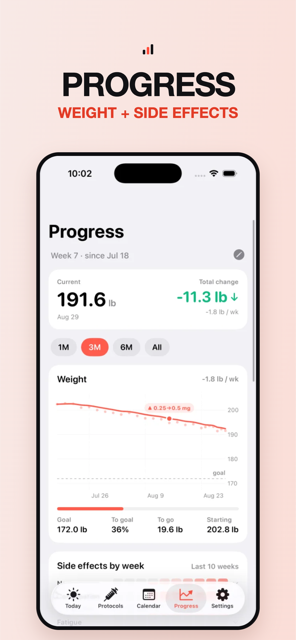
- Weight. A weight chart with step-up markers on it answers "did the last increase do anything?" at a glance, instead of scrolling back through messages to find the date.
- The next appointment. "Four weeks at 5 mg" is a date. A tracker should know it before you do.
Compounded Compounded Semaglutide and Compounded Tirzepatide add a wrinkle: doses are in units from a vial, so a step-up means a new number of units to draw. See compounded semaglutide and tirzepatide units for the maths.
How to do this in Peppy
Titration steps are a Pro feature. Everything here assumes the ladder came from your prescriber; Peppy does not suggest one.
- Open Protocols, tap + and search for your medication (Wegovy, Ozempic, Mounjaro, Zepbound, Saxenda and 16 other GLP-1s are in the catalog). The dose ladder from the catalog is shown in the editor, labelled as a listing, not a recommendation.
- Turn on Titration (Pro) in the editor. Enter each step as your prescriber set it: the dose and how long to stay on it. Steps default to 4 weeks for the weekly pens and 1 week for Saxenda; change any of them. Delete rungs you will not use, or add a hold step at the same dose.
- Save. The protocol card on Today, the reminder notification (Pro) and the Log shot sheet all show the current step's dose. When a step's duration ends, Peppy advances to the next dose automatically. For a vial protocol the units to draw update at the same time.
- Log weight in the daily check-in (or let Peppy read it from Apple Health). In the Progress tab (Pro), the weight trend shows a marker on each step-up date, and the side-effect heat-map lines up by week so you can see what each step did.
- If your prescriber holds you at a step, open the protocol and edit the step's duration, or pause titration entirely. Peppy keeps the history of every dose you actually logged, so the record stays accurate even when the plan changes.
Always verify with your prescriber. Peppy tracks the schedule you were given; it never decides when to move up.

Track it in Peppy
123 compounds built in, the units math done for you, body-map site rotation and reminders — private on your iPhone.
 Free · iPhone · no account
Frequently asked
What is the Wegovy titration schedule?
The Wegovy label's escalation table is 0.25 mg weekly for weeks 1–4, 0.5 mg for weeks 5–8, 1 mg for weeks 9–12, 1.7 mg for weeks 13–16, then a maintenance dose of 1.7 mg or 2.4 mg from week 17. The label also says the escalation can be delayed if a step is not tolerated; that is your prescriber's decision.
What is the Zepbound or Mounjaro titration schedule?
Both labels start at 2.5 mg once weekly for 4 weeks, then increase in 2.5 mg increments after at least 4 weeks on the current dose. Zepbound's label lists 5, 10 and 15 mg as maintenance doses for weight reduction; 15 mg is the maximum for both.
How long do you stay on each GLP-1 dose?
The labels use 4 weeks as the minimum at each step. Many people stay longer on a step at their prescriber's direction, often because of side effects. A GLP-1 titration tracker should let you set any duration, not just 4 weeks.
Why do side effects get worse after a dose increase?
The Zepbound label notes that most nausea, vomiting and diarrhea events occurred during dose escalation and decreased over time. Logging side effects against the day of each step-up lets you and your prescriber see whether a step is settling or not.
Can a tracker change my dose automatically?
Peppy advances the dose it displays when a titration step's duration is up, so cards, reminders and the log sheet show the new amount. It does not decide the schedule; you enter the ladder your prescriber gave you, and you can edit or pause it at any time.
Sources
- Wegovy prescribing information, section 2.2 Table 1 — Novo Nordisk (DailyMed)
- Ozempic prescribing information, section 2.2 — Novo Nordisk (DailyMed)
- Mounjaro prescribing information, section 2.1 — Eli Lilly (DailyMed)
- Zepbound prescribing information, sections 2.1–2.2 and 6.1 — Eli Lilly (DailyMed)
- Saxenda prescribing information, section 2 Table 1 — Novo Nordisk (DailyMed)
Not medical advice. Peppy is a tracking tool, not medical advice. Dose calculations are mathematical conversions only. Always follow your prescriber's instructions and verify every draw-up yourself.