Flushing on peptides and NAD+: what to track, when it shows up, and how to log it
Flushing is a sudden warmth and redness across the face, neck and chest. It is one of the most widely reported effects of NAD+ injections, and many people also describe it with GHRP-6, GHRP-2, hexarelin and other growth hormone secretagogues. None of these has a label with a flushing rate, so there are no numbers to quote. Log it per shot with timing and a 1–5 score, and it usually shows a clear shot-to-flush pattern within a week.
Peptide flushing: what it is and who reports it
Peptide flushing is the sudden warmth that climbs up the neck and into the face, often with visible redness across the cheeks and upper chest, sometimes with a tight or heavy feeling behind the breastbone. It tends to arrive within minutes of a shot and leave within an hour. It is not an injection site reaction; the skin at the needle site can be perfectly calm while the face is red.
The compound it is reported with most is NAD+. Flushing after a subcutaneous NAD+ shot is widely described, often with nausea or a brief headache alongside, and many people say it is the reason they slow a shot down or split it. After NAD+, the older growth hormone releasing peptides come up most: GHRP-6, GHRP-2 and Hexarelin, with a briefer warm face reported. Ipamorelin and CJC-1295 / Ipamorelin users describe it less often. It is not a notable GLP-1 reaction.
None of these compounds has a current FDA label, so there is no rate, no placebo comparison and no official mechanism. Everything on this page about frequency and timing is what people report, not a measured figure. Peppy tracks flushing as its own item so you can build your own numbers instead.
When it tends to show up
Flushing is unusual among side effects in being tied to the clock rather than the calendar. Many people report it starts within a few minutes of an NAD+ shot, peaks in the first 15 to 30 minutes, and is gone within an hour. With GHRPs the description is usually shorter still. That makes it one of the easiest patterns to confirm: if the flush arrives on a predictable delay after every shot, you have your answer within a week.
What people report changes it: the size of the dose they are on, how fast the shot goes in, the time of day, whether they ate beforehand, heat, alcohol and exercise. Whether any of those matter for you is what the log is for. This is also one of the few side effects where a shot note beats a daily check-in, because the whole event is over before the day is.
If you are running more than one compound, the flush may follow just one of them. A stacked protocol with NAD+ and a GH secretagogue on the same day is hard to read without colour-coded shots; the peptide stack tracker guide covers how to keep them separate.
What is worth logging
- Severity, 1–5, per shot. A 1 is a faint warmth you would not mention; a 5 is a red face and chest that stops you doing anything for a while.
- Onset and duration, in the shot note. "Started 5 min, gone by 45" is the whole finding. Timing is what separates a drug effect from a warm room.
- Which shot. Log every shot against its protocol so the flush attaches to the compound, not the day.
- Site and speed. Many NAD+ users report the site and how quickly they push the plunger change things. Log the site on the body map; put "slow push" or "fast" in the note.
- Nausea, headache and dizziness alongside. They often travel with NAD+ flushing. Score nausea, headache and dizziness in the check-in so the cluster is visible.
- Food, alcohol, heat, exercise in the note. All four flush people on their own.
When to contact your prescriber
Predictable, short, mild flushing is what most people describe. Some things that can look like flushing are not.
- Hives, swelling of the face, lips, tongue or throat, wheezing or trouble breathing. That is hypersensitivity, not flushing. Emergency care.
- Flushing with chest pain, a racing or irregular heartbeat, or feeling faint. Same-day call at minimum; emergency care if it does not pass quickly.
- Flushing that lasts hours, is getting worse with each shot, or comes with a rash or fever. Bring the log. Whether anything about the protocol should change is your prescriber's decision.
- A heart, blood pressure or thyroid condition, or a medicine that already causes flushing. A new source of flushing is something that prescriber wants to know about.
Peppy shows you when flushing happens and what it lines up with. It does not tell you what to change.
How to do this in Peppy
- Turn flushing on. Open Settings ▸ Tracking and toggle Flushing. It is not one of the GLP-1 defaults, so it is off until you add it. Nausea and Headache are in the same list.
- Log the shot on the body map, with the timing in the note. Tap the dose on the Today tab. Tap the site you used on the silhouette, confirm the time, and write the note after the flush has passed: "started 5 min, peaked 20, gone by 45, slow push". You can edit a past log if you want to add it later.
- Score it in the daily check-in. Tap the check-in row on the Today tab and set flushing 1–5 for the worst moment of the day. Score nausea, headache and dizziness alongside if they came with it.
- Keep each compound on its own protocol. Peppy colour-codes protocols on the Today tab and Calendar. With NAD+ on one colour and a GH secretagogue on another, the flush attaches to the right shot. Free covers one active protocol; unlimited protocols are Pro.
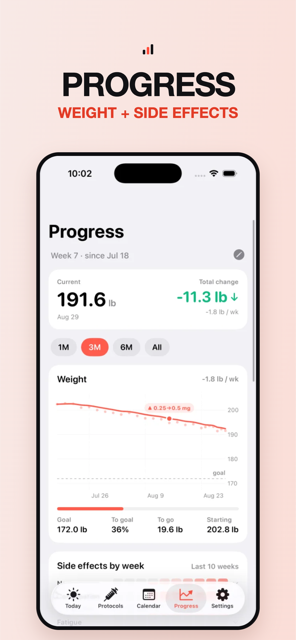
- Read the weekly heat-map in Progress (Pro). The flushing row sits on the same week axis as nausea and headache with step-ups marked. A row that only darkens on NAD+ days is the finding. Free users see the chart blurred.
- Use the Calendar to confirm the shot-to-flush link. Tap a day, see each shot with its protocol colour and site, and compare against that day's check-in.
- Export before an appointment (Pro). Settings ▸ Export produces a PDF or CSV of doses and check-ins, notes included. The export guide covers what is in it.
Related: injection site reaction, headache, the injection site rotation guide and the side-effects tracking guide.

Track it in Peppy
123 compounds built in, the units math done for you, body-map site rotation and reminders — private on your iPhone.
 Free · iPhone · no account
Frequently asked
Why does NAD+ make you flush?
NAD+ is a research compound with no FDA label, so there is no label explanation or rate. Many people report a warm, red, sometimes tight-chested feeling starting minutes after a subcutaneous shot and passing within an hour or so. The shot-to-flush timing is consistent enough that most people can predict it after a few doses.
Does ipamorelin cause flushing?
Ipamorelin is a research compound with no label. Flushing is reported less often with it than with NAD+ or the older GHRPs, but some people describe a brief warm face shortly after a shot. It is worth logging with the shot time so you can see whether it is consistent or coincidental.
How long does peptide flushing last?
No label gives a duration. Many people report NAD+ flushing peaks within the first 15 to 30 minutes and is gone within an hour; GH secretagogue flushing is usually described as shorter. A 1–5 score with a note on how long it lasted turns those reports into your own numbers.
Is flushing the same as an allergic reaction?
Not usually. Flushing is warmth and redness that fades on its own. Hives, swelling of the face, lips or throat, wheezing or trouble breathing are hypersensitivity and an emergency, whatever compound you took. Log flushing; do not log an allergic reaction, call for help.
When should I tell my prescriber about flushing?
Flushing with chest pain, palpitations, faintness or breathing trouble is not a tracking question. Flushing that is getting worse with each shot, lasting hours, or coming with a rash or fever is worth a call with your log in hand. Mild, predictable, short-lived flushing is what most people describe.
Not medical advice. Peppy is a tracking tool, not medical advice. Dose calculations are mathematical conversions only. Always follow your prescriber's instructions and verify every draw-up yourself.