Nausea on GLP-1s: what to track, when it tends to show up, and how to log it
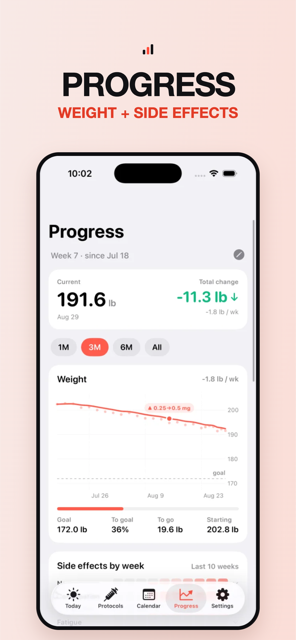
Nausea is the most common side effect on every GLP-1 label: Wegovy lists it in 44% of trial participants, Saxenda 39%, Zepbound 25–29%. The labels say most of it happens during dose escalation and eases over time. Log severity 1–5 each day, note how many days after your shot it lands, and compare weeks against step-ups so you and your prescriber can see the pattern.
GLP-1 nausea: what it is and who reports it
GLP-1 nausea is the queasy, off-your-food feeling that shows up on the first line of every GLP-1 label. Semaglutide (Ozempic, Wegovy, compounded semaglutide), tirzepatide (Mounjaro, Zepbound, compounded tirzepatide) and liraglutide (Saxenda) all slow how fast your stomach empties. For a lot of people that is the mechanism behind both the appetite effect and the nausea.
The prescribing information gives the clearest numbers you will find anywhere:
| Label | Nausea (drug) | Nausea (placebo) |
|---|---|---|
| Wegovy 2.4 mg | 44% | 16% |
| Saxenda | 39.3% | 13.8% |
| Zepbound 5 / 10 / 15 mg | 25% / 29% / 28% | 8% |
| Ozempic 0.5 / 1 mg | 15.8% / 20.3% | 6.1% |
| Mounjaro 5 / 10 / 15 mg | 12% / 15% / 18% | 4% |
Those are trial populations, not a forecast for you. The weight-management trials (Wegovy, Zepbound, Saxenda) report higher rates than the diabetes trials (Ozempic, Mounjaro), partly because the maintenance doses are higher. Compounded Compounded Semaglutide and Compounded Tirzepatide have no label of their own; the branded figures are the closest reference you have.
When it tends to show up
Two patterns come up again and again, one from the labels and one from people's logs.
Dose-escalation weeks. Wegovy's label says gastrointestinal reactions "were most frequently reported during dosage escalation". Mounjaro's and Zepbound's say "the majority of reports of nausea, vomiting, and/or diarrhea occurred during dose escalation and decreased over time". Wegovy's schedule steps up every four weeks (0.25 mg, 0.5 mg, 1 mg, 1.7 mg, then 2.4 mg); Zepbound starts at 2.5 mg for four weeks and moves in 2.5 mg increments after at least four weeks on a dose. So the weeks right after a step-up are where many people notice the biggest change, and the label itself says to "consider delaying dosage escalation for 4 weeks" if a dose is not tolerated, which is a decision for your prescriber.
The first 24–72 hours after a weekly shot. Many people report that nausea is worst on day one to three and fades toward the end of the week. Zepbound's label puts the median time to peak concentration at 24 hours, with a range of 8 to 72 hours. That does not prove the two are linked for you, but it is a reason to log the day-of-week and not just the severity.
Saxenda, a daily shot, follows a different rhythm. Its label notes that "the percentage of patients reporting nausea declined as treatment continued", so the useful comparison there is week over week rather than day over day.
What is worth logging
A nausea log is only useful if it can be lined up against something. Keep these four things and you will be able to answer most of the questions a prescriber asks.
- Severity, 1–5, once a day. Same time every day so the numbers are comparable. A 2 that lasts all week and a 5 that lasts one evening are different stories.
- Days since your last shot. Not the calendar date, the offset. "Day 2 after the shot" is what turns a list of numbers into a pattern.
- Which dose you were on. Every step-up is a new baseline. Nausea at 0.5 mg in week 6 and nausea at 1 mg in week 9 should be compared separately.
- A one-line note. What you ate, how much you drank, whether you skipped a meal. You are not trying to diagnose anything, just giving future-you context.
Weight belongs in the same log. Weeks where nausea is high are often weeks where food intake drops, and seeing weight and nausea on the same timeline stops you from reading one without the other. See the GLP-1 weight tracker guide for how Peppy pulls weight from Apple Health.
When to contact your prescriber
This is not a treatment page and nothing here replaces your prescriber. The labels are explicit about a few red flags, and they are worth knowing word for word.
- Persistent or severe abdominal pain, "sometimes radiating to the back", "which may or may not be accompanied by nausea or vomiting". Every GLP-1 label lists this under the pancreatitis warning.
- Nausea, vomiting or diarrhea that leads to dehydration. The Wegovy, Mounjaro and Zepbound labels say most reported cases of acute kidney injury occurred in patients who had gastrointestinal reactions leading to dehydration.
- Nausea that stops you eating or drinking for more than a day. The labels list discontinuation for GI reactions in 4.3% of Wegovy patients and 6.2% of Saxenda patients. That is a prescriber conversation, not a self-adjustment.
Anything that feels different in kind, not just degree, is a reason to call. A clean log makes that call shorter.
How to do this in Peppy
- Make sure nausea is switched on. It is one of Peppy's five GLP-1 defaults, so if you picked a GLP-1 during onboarding it already is. Otherwise go to Settings ▸ Tracking and toggle Nausea on. You can track up to 28 side effects.
- Log it in the daily check-in. On the Today tab, tap the check-in row. Set nausea from 1 to 5, add your weight, and drop what you ate or drank into the note. It takes under a minute, and it counts toward your streak.
- Log the shot itself. When you take your weekly dose, log it from the Today tab or the Next Shot widget (Pro). Peppy records the time, the site on the body map and the dose you were on, which is the "days since" and "which dose" half of the log.
- Read the heat-map in Progress (Pro). The Progress tab lays out side effects by week as a heat-map, with step-up markers from your titration ladder on the same timeline. Dark cells right after a step-up, fading over the following weeks, is the pattern the labels describe. Free users see the chart blurred.
- Use the Calendar for the shot-day relationship. The month grid shows taken, skipped and missed dots. Open a week and you can see whether your worst check-ins sit on day one to three after a shot or spread evenly.
- Export it before an appointment (Pro). Settings ▸ Export gives you a PDF or CSV of doses and check-ins. Peppy never sends it anywhere itself. The export guide walks through it.
If you also want to track food noise and appetite alongside nausea, the side-effects and food-noise guide covers the whole check-in setup. Related pages: vomiting, sulfur burps, suppressed appetite.

Track it in Peppy
123 compounds built in, the units math done for you, body-map site rotation and reminders — private on your iPhone.
 Free · iPhone · no account
Frequently asked
How long does GLP-1 nausea last?
The labels do not give a fixed number of days. Wegovy's prescribing information says gastrointestinal reactions were most frequently reported during dosage escalation, and the Mounjaro and Zepbound labels say most nausea occurred during dose escalation and decreased over time. Many people report it easing within a few weeks of each step-up, but it varies. A daily 1–5 log shows your own timeline.
Does nausea get better after the first month?
For many people it does, and the labels support the general direction: nausea clusters around escalation and declines as treatment continues. Saxenda's label states that the percentage of patients reporting nausea declined as treatment continued. Track it through each dose change rather than assuming a calendar month.
Is nausea worse on shot day or the day after?
Many people report the worst stretch in the first one to three days after a weekly shot. Zepbound's label gives a median time to peak concentration of 24 hours (range 8 to 72 hours), which lines up with that anecdote. Logging severity with the day-of-week next to your shot day is the only way to know your own pattern.
What percentage of people get nausea on Wegovy or Ozempic?
Wegovy's label lists nausea in 44% of participants versus 16% on placebo. Ozempic's label lists 15.8% at 0.5 mg and 20.3% at 1 mg versus 6.1% on placebo. Mounjaro's label lists 12–18% depending on dose; Zepbound's 25–29%; Saxenda's 39.3%.
When should I call my doctor about nausea on a GLP-1?
The labels flag persistent or severe abdominal pain, sometimes radiating to the back, with or without nausea or vomiting, as a possible sign of pancreatitis. They also warn that nausea, vomiting or diarrhea leading to dehydration has been linked to acute kidney injury. If nausea is stopping you from keeping fluids down, contact your prescriber.
Sources
Not medical advice. Peppy is a tracking tool, not medical advice. Dose calculations are mathematical conversions only. Always follow your prescriber's instructions and verify every draw-up yourself.