Tracking GLP-1 side effects and food noise against your dose days
A GLP-1 side effects tracker is only useful if each entry is tied to where you are in the dose cycle. Rate the handful of things that matter to you (nausea, constipation, food noise, energy) once a day on a 1–5 scale, and look at them by week and by step-up rather than as a list. Patterns like 'worse for three days after each shot' only appear when the dose day is on the same chart.
What people mean by food noise
A GLP-1 side effects tracker has one job that a plain diary does not: it puts every symptom next to the day you took your shot. Before getting to that, it helps to name the thing people most want to track, because it is not on any label.
Food noise is the everyday term for constant, intrusive thoughts about food: planning the next meal while eating this one, thinking about the snack cupboard during a meeting, hunger that is more mental than physical. It is not a diagnosis. Researchers have started to treat it as a measurable construct; a 2026 review in the NIH's PMC library describes it as persistent, cue-driven, future-oriented thoughts about food, and a five-item Food Noise Questionnaire now exists to score it. In a 417-adult cohort presented at the European Congress on Obesity in May 2026, people who started a GLP-1 alongside a behavioral weight program reported a larger one-month drop in food-noise scores than those in the program alone. Many people on semaglutide or tirzepatide describe the same thing informally: the noise goes quiet, sometimes within the first two weeks.
That makes food noise worth logging for the opposite reason to nausea. Nausea is something you hope goes down. Food-noise relief is something you hope stays, and its return toward the end of a dose week, or when a shot is late, is exactly the kind of pattern a tracker can surface. There is more on the food noise page.
The common GLP-1 side effects, with label numbers
The labels publish incidence from the pivotal trials. These are the figures for the most frequent reactions, alongside placebo, so you can see how much is the drug and how much is life.
| Reaction | Wegovy 2.4 mg (placebo) | Zepbound 5 / 10 / 15 mg (placebo) | Ozempic 0.5 / 1 mg (placebo) |
|---|---|---|---|
| Nausea | 44% (16%) | 25% / 29% / 28% (8%) | 15.8% / 20.3% (6.1%) |
| Diarrhea | 30% (16%) | 19% / 21% / 23% (8%) | 8.5% / 8.8% (1.9%) |
| Vomiting | 24% (6%) | 8% / 11% / 13% (2%) | 5% / 9.2% (2.3%) |
| Constipation | 24% (11%) | 17% / 14% / 11% (5%) | 5% / 3.1% (1.5%) |
| Abdominal pain | 20% (10%) | 9% / 9% / 10% (5%) | 7.3% / 5.7% (4.6%) |
| Headache | 14% (10%) | — | — |
| Fatigue | 11% (5%) | 5% / 6% / 7% (3%) | — |
| Eructation (burping) | 7% (<1%) | 4% / 5% / 5% (1%) | — |
Two label notes matter for tracking. The Zepbound label says most nausea, vomiting and diarrhea events occurred during dose escalation and decreased over time. And the burping row is where the sulfur burps people talk about online live; the trials called it eructation. Anything severe, persistent or frightening is a call to your prescriber, not a line in a log.
Why the dose day has to be on the chart
Suppose you write "nausea 3/5" on twelve days in a month. On its own that is a number. Put your Thursday shots on the same timeline and it might become "3/5 on Friday and Saturday, 1/5 by Monday, every week", which is a rhythm you can plan around. Or it might become "3/5 every day since the step to 1 mg", which is a conversation with your prescriber, and one where you can show them the data rather than describe it.
The same goes for the good side. Appetite control, energy, sleep and food noise tend to move with the dose cycle too. When a shot is late, many people report the noise creeping back a day or two earlier than usual. Seeing that once is enough to make the missed-dose rules feel real.
The trick is to keep the daily entry small enough that you actually do it. Five things on a 1–5 scale takes twenty seconds. A free-text diary takes five minutes and dies in week three.
How to do this in Peppy
The daily check-in is free. The heat-map and the other Insights charts are Pro.
- Open Settings ▸ Check-in and choose what to track. For a GLP-1 the defaults are nausea, constipation, heartburn, sulfur burps and food noise, plus the feelings energy, sleep, mood and appetite control. Turn any of the 28 side effects and 12 feelings on or off.
- Each day, tap the check-in row on the Today tab. Rate each side effect and feeling from 1 to 5, enter your weight (or let Apple Health fill it), add a note if something stood out, and optionally a progress photo (Pro). Done in under a minute.
- Turn on the check-in reminder in Settings ▸ Reminders (Pro) so the evening prompt does the remembering. Check-ins count toward your streak alongside doses.
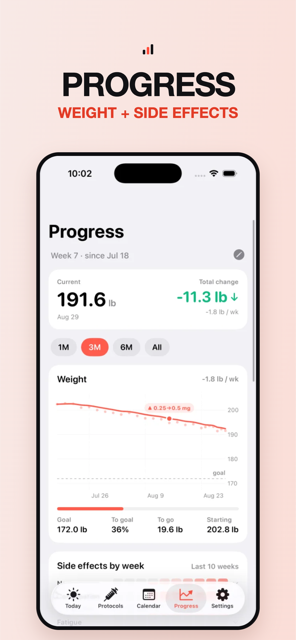
- Open Progress (Pro). The side-effect heat-map lays out each tracked side effect by week, darker where scores were higher, with your dose days and titration step-ups marked. The feelings chart does the same for energy, appetite control and the rest.
- Before an appointment, use Settings ▸ Export (Pro) to generate a PDF report of doses and check-ins for the period, or a CSV if your clinic prefers a spreadsheet. See exporting your dose log.
Peppy shows you the pattern. What to do about it, from timing a shot differently to holding a step, is a decision for you and your prescriber.

Track it in Peppy
123 compounds built in, the units math done for you, body-map site rotation and reminders — private on your iPhone.
 Free · iPhone · no account
Frequently asked
What is food noise?
Food noise is the term people use for constant, intrusive thoughts about food that show up whether or not you are hungry. Researchers now measure it with a short Food Noise Questionnaire, and a 2026 cohort study of 417 adults presented at the European Congress on Obesity reported a larger one-month drop in scores among those who started a GLP-1 alongside a behavioral program than those who did not. Many people on GLP-1s describe it going quiet within the first weeks.
What are the most common GLP-1 side effects?
Gastrointestinal ones. The Wegovy label reports nausea in 44% of patients (16% on placebo), diarrhea 30%, vomiting 24% and constipation 24%. The Zepbound label reports nausea in 25–29% across doses, diarrhea 19–23% and constipation 11–17%. The labels note most of these occur during dose escalation and ease over time.
Why should I track side effects by dose day?
Because the timing is the information. Nausea that peaks two days after each weekly shot and fades by day five is a different story from nausea that is flat all week, and a step-up that doubles your scores for a fortnight is worth showing your prescriber. Without the dose day on the chart, both look like 'some nausea'.
Does a GLP-1 side effects tracker work for peptides too?
Yes. Peppy's check-in has 28 side effects and 12 feelings to choose from, and you pick which ones to track. Someone on a research peptide might follow injection site reactions, sleep and recovery instead of nausea and food noise.
Can I share my side-effect log with my doctor?
Peppy's Export (Pro) produces a PDF report or a CSV of doses and check-ins that you can hand over. Peppy never sends it anywhere itself.
Sources
- Wegovy prescribing information, section 6.1 — Novo Nordisk (DailyMed)
- Zepbound prescribing information, section 6.1 — Eli Lilly (DailyMed)
- Ozempic prescribing information, section 6.1 — Novo Nordisk (DailyMed)
- Quieting 'Food Noise': How GLP-1s and Mindfulness Rewire the Default Mode Network and Reward Circuits — PMC, 2026
- Pennington Biomedical / ECO 2026: GLP-1 use alongside behavioral intervention associated with reduced food noise (417-adult cohort, Food Noise Questionnaire)
Not medical advice. Peppy is a tracking tool, not medical advice. Dose calculations are mathematical conversions only. Always follow your prescriber's instructions and verify every draw-up yourself.