Dizziness on GLP-1s: what the labels list, what usually sits behind it, and how to log it
Dizziness is a listed adverse reaction on the GLP-1 labels. Wegovy reports it in 8% of patients versus 4% on placebo, Zepbound 4–5% versus 2%, Saxenda 6.9% versus 5%, and Ozempic lists it among reactions above 0.4%. The labels give no cause. Many people find it tracks with dehydration, eating very little, or low blood sugar. Score it 1–5 with a note on food, fluids and standing up, and compare shot days with the rest of the week.
GLP-1 dizziness: what it is and who reports it
GLP-1 dizziness is the head-rush when you stand up from the sofa, the lightheaded minute in the shower, the afternoon where the room feels a half-step behind you. Semaglutide (Ozempic, Wegovy) and tirzepatide (Mounjaro, Zepbound) list it on their labels, and unlike heartburn or dehydration, it gets its own row in most of the adverse-reaction tables.
| Label | Dizziness (drug / placebo) | Fatigue (drug / placebo) |
|---|---|---|
| Wegovy 2.4 mg | 8% / 4% | 11% / 5% |
| Zepbound 5 / 10 / 15 mg | 4% / 5% / 4% vs 2% | 5% / 6% / 7% vs 3% |
| Saxenda | 6.9% / 5% | 7.5% / 4.6% |
| Ozempic 0.5 / 1 mg | listed among reactions above 0.4%, not tabulated | same |
| Mounjaro 5 / 10 / 15 mg | not tabulated (table covers 5% and above) | not tabulated |
Fatigue is in the table because it is the effect people most often report alongside dizziness, and the numbers move together on every label that lists both. What the labels do not do is explain the dizziness. There is no mechanism paragraph. That leaves three ordinary suspects, each with its own page: dehydration, eating far less than you used to, and low blood sugar, which the labels flag mainly for people also taking insulin or a sulfonylurea. Compounded Compounded Semaglutide and Compounded Tirzepatide have no label; the branded numbers are your reference.
When it tends to show up
The labels do not time dizziness on its own. Their timing sentence is about gastrointestinal reactions: Wegovy's says they were "most frequently reported during dosage escalation", and Mounjaro's and Zepbound's say most nausea, vomiting and diarrhea occurred during escalation and decreased over time.
What people report is that dizziness follows the intake curve. Many say it shows up on days two and three after a shot, when nausea is highest and they have eaten the least. Many say the week after a step-up is worse, for the same reason. A smaller group reports it mostly on standing, first thing in the morning or after a hot shower, and finds it is a fluid question more than a food question. And people on insulin or a sulfonylurea often report a different flavour: sudden, sweaty, with hunger, mid-morning, which is the pattern that needs a meter and a prescriber.
The question a log answers is which of those you are. Shot-day dizziness, low-intake dizziness, standing-up dizziness and low-sugar dizziness each leave a different footprint over three or four weeks.
What is worth logging
- Severity, 1–5, daily. Score the worst moment. 1 is a brief head-rush, 5 is needing to sit down or nearly fainting.
- What triggered it, in the note. "On standing", "after skipping lunch", "hot shower", "2 hours after shot". One phrase is enough.
- Food and fluid for the day. "Barely ate", "about 1 L water", "coffee only until 2pm". This is the note that usually solves it.
- A glucose reading if you have a meter. Especially if you take insulin or a sulfonylurea. A number next to the symptom is worth more than any adjective.
- Days since your shot and the dose you were on. Log shots in the same app and both are automatic.
- Nausea, fatigue and headache alongside. See nausea, fatigue and headache. Four rows darkening together tells a cleaner story than one.
When to contact your prescriber
Dizziness is not a red-flag reaction on any GLP-1 label. Some of the things that can sit behind it are.
- Fainting, or nearly fainting. Urgent, not a tracking question.
- Dizziness with vomiting or diarrhea that is not settling. Every label links gut losses to dehydration and, from there, to acute kidney injury. Call the same day if you cannot keep fluids down.
- Dizziness with shakiness, sweating and confusion, particularly if you take insulin or a sulfonylurea. The labels warn about hypoglycemia in that combination, and say the fix may be a change to the other medicine. Your prescriber makes that call.
- A racing or irregular heartbeat, or chest pain. Treat as an emergency.
- Daily dizziness that is not settling after a step-up. The labels say to consider delaying escalation if a dose is not tolerated. The log turns that into a short conversation.
How to do this in Peppy
- Turn dizziness on. It is not one of the five GLP-1 defaults. Open Settings ▸ Tracking and toggle Dizziness. Dehydration, Low blood sugar and Fatigue are in the same list; turn on the ones that apply.
- Score it in the daily check-in. On the Today tab tap the check-in row. Set dizziness 1–5, write the trigger and the food-and-fluid note, score energy under feelings, and add your weight. The check-in counts toward your streak.
- Log shots with the body map. Tap the dose on the Today tab, tap the site on the silhouette, confirm the time. The dose is saved with the shot, so your titration ladder (Pro) becomes step-up markers on the charts.
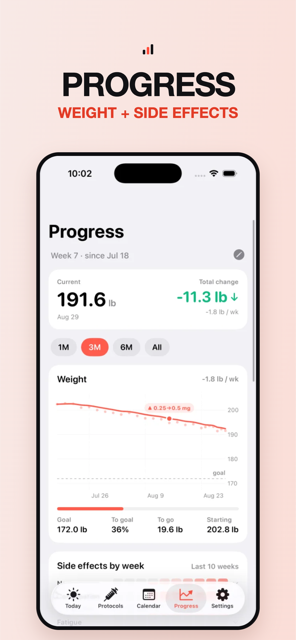
- Read the heat-map in Progress (Pro). The dizziness row sits with dehydration, fatigue and nausea on one week axis, step-ups marked. A row that darkens two days after every shot is intake-driven; one that darkens on random weekdays with a "skipped lunch" note is food-driven. The free tier shows the chart blurred.
- Use the Calendar for the shot-day question. The week strip shows shot days. Flip through check-ins and compare day two after a shot with day six.
- Export before an appointment (Pro). Settings ▸ Export produces a PDF or CSV of doses and check-ins including your notes. The export guide covers what is in it.
Related: the side-effects tracking guide, the Wegovy tracker and the Zepbound tracker pages.

Track it in Peppy
123 compounds built in, the units math done for you, body-map site rotation and reminders — private on your iPhone.
 Free · iPhone · no account
Frequently asked
Does Wegovy cause dizziness?
Wegovy's label lists dizziness in 8% of patients versus 4% on placebo. Fatigue is listed in the same table at 11% versus 5%, and the two often travel together. The label does not say what causes the dizziness.
Why do GLP-1s make you dizzy?
The labels list dizziness without a mechanism. Many people report it on days they have eaten and drunk very little, or after a stretch of nausea or vomiting, which points to dehydration and low intake. In people who also take insulin or a sulfonylurea, low blood sugar is the other thing to rule out. A log with a food and fluid note usually sorts these out within a few weeks.
How long does GLP-1 dizziness last?
The labels do not give a duration for dizziness. They say gastrointestinal reactions as a group were most common during dose escalation and decreased over time, and many people report dizziness follows the same curve because it follows the low-intake days. If yours is daily and not settling, that is a prescriber conversation.
Is dizziness on Mounjaro or Zepbound common?
Zepbound's label lists dizziness at 4%, 5% and 4% for 5, 10 and 15 mg versus 2% on placebo. Mounjaro's label does not tabulate it separately; its table covers reactions in 5% or more of patients and dizziness was below that. Both labels warn that combining with insulin or a sulfonylurea raises the risk of hypoglycemia, which can present as dizziness.
When is GLP-1 dizziness a reason to call the doctor?
Fainting or near-fainting, dizziness with vomiting you cannot stop, dizziness with a racing heart or chest pain, or a spell with confusion is urgent. Dizziness that is new, daily and not settling after a step-up is a same-week call. Bring the log.
Sources
Not medical advice. Peppy is a tracking tool, not medical advice. Dose calculations are mathematical conversions only. Always follow your prescriber's instructions and verify every draw-up yourself.