NAD+ injections: units to draw, big-volume shots and an every-other-day schedule
NAD+ is an essential cellular coenzyme involved in energy metabolism, DNA repair and sirtuin activation; it declines with age and is supplemented for cellular health and longevity. The Peppy catalog lists it as a reconstituted vial dosed in mg, typically every other day, with no half-life on file. Peppy converts vial and water into units, flags oversized draws and keeps the schedule.
NAD+ reconstitution calculator
NAD+ reconstitution calculator
Free in the appNAD+ dose steps in the catalog
| NAD+ — catalog dose ladder | Dose |
|---|---|
| Step 1 | 100 mg |
| Step 2 | 250 mg |
| Step 3 | 500 mg |
| Step 4 | 1000 mg |
Dose steps as listed in the Peppy catalog so the picker is fast — not a recommendation. Your prescriber sets your dose; Peppy tracks it.
Tracking NAD+: what matters
NAD+ is the odd one out in the vial catalog because the doses are measured in hundreds of milligrams. That turns a NAD+ reconstitution calculator into a syringe-capacity problem. A 500 mg vial with 5 mL of water is 100 mg per mL, so 100 mg is a full 1 mL syringe and 250 mg is two and a half of them. Peppy warns when a dose will not fit a 1 mL draw, and the fix is usually less water for a higher concentration, which Peppy recalculates as you type. Whether that concentration is appropriate is a question for your prescriber; the units-to-draw guide covers the arithmetic.
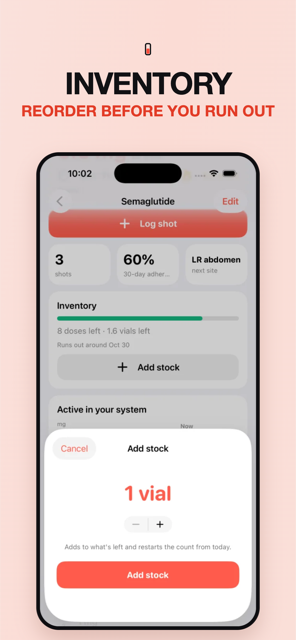
The vial count follows the same logic. A 500 mg vial is five 100 mg shots or two 250 mg shots, so inventory (Pro) is worth setting up: vials times doses per vial gives "≈ 4 doses left, runs out around Oct 3" and a running-low alert. See vial inventory.
The other thing people track with NAD+ is how the shot felt. Flushing and nausea around the shot are common reports, and injection-site soreness scales with volume. The daily check-in rates side effects 1 to 5 and a note on the log records the site and volume, so the pattern is visible in Progress (Pro insights) rather than in your memory. There is no half-life on file, so Peppy shows no "active in your system" curve.
Schedule and cycles
The Peppy catalog lists NAD+ as every other day, with a dose ladder of 100, 250, 500 and 1000 mg (catalog listing, not a recommendation). Tracked patterns include alternate days, daily shots for a block, and two or three fixed weekdays. Peppy's every-other-day schedule shows the next shot two days out; a custom weekday schedule covers fixed days; cycles (Pro) auto-skip the off weeks in an on/off block so they never show as missed. Dose step-ups (Pro) model a ramp through the ladder with a duration per rung, and the units update with each step. The pattern is your prescriber's decision.
How to do this in Peppy
- Open Protocols, tap +, search "NAD". The catalog sets vial, mg and every other day.
- Enter the mg dose. In the inline Calculator, type vial mg and water mL; if Peppy warns about the 1 mL limit, adjust the water.
- Confirm the every-other-day schedule or pick weekdays. Add Dose step-ups (Pro) if you ramp.
- Enter vials in Inventory (Pro).
- Log from Today, tapping the suggested site on the body map. Add a note if the shot stung.
- Do the check-in later that day and rate flushing or nausea so it lands next to the shot.
Running NAD+ alongside MOTS-c or other longevity compounds? The stack tracker guide shows how the Today tab groups them.

Track it in Peppy
123 compounds built in, the units math done for you, body-map site rotation and reminders — private on your iPhone.
 Free · iPhone · no account
Frequently asked
How many units is 100 mg of NAD+?
Example: a 500 mg vial mixed with 5 mL of bacteriostatic water is 100 mg per mL, so 100 mg is 1 mL, or 100 units, a full U-100 syringe. A 250 mg dose at that concentration is 2.5 mL and will not fit one syringe; Peppy warns you. With 2.5 mL of water, 100 mg is 50 units. Run your vial through Peppy's calculator and verify with your prescriber.
How often is NAD+ typically scheduled?
The Peppy catalog lists NAD+ injections as every other day. People also log daily shots or a few fixed weekdays. Peppy's every-other-day schedule, daily schedule and custom weekdays cover those; cycles (Pro) handle on/off blocks. Your prescriber sets the pattern.
What is the half-life of NAD+?
The Peppy catalog does not list one, so no "active in your system" chart is shown. NAD+ is a coenzyme with fast turnover and published human pharmacokinetic data for injections are limited, so Peppy does not estimate a number it cannot source.
Where do you inject NAD+?
Most people log subcutaneous sites on the abdomen or thighs. Larger volumes are one reason to rotate carefully; Peppy's body map suggests the next site and shows "last used 2 days ago". See the rotation guide.
Can I track NAD+ if I do it as a nasal spray or IV?
Yes. Log a custom compound with the form you use and a dose in mg. The body map and units calculator only appear for injectable vials.
Can I track NAD+ in Peppy?
Yes. NAD+ is one of 123 compounds built into Peppy, with its form, unit and typical frequency prefilled. Add it as a protocol, set your schedule, and Peppy handles the countdown, the log and the reminders (Pro).
Where should I inject NAD+?
Follow your prescriber's instructions. For subcutaneous shots the GLP-1 labels list the abdomen, thigh and upper arm and say to rotate. Peppy's body map has 13 sites, suggests the next one, and shows when each was last used. Read the site rotation guide.
More in Longevity
Not medical advice. Peppy is a tracking tool, not medical advice. Dose calculations are mathematical conversions only. Always follow your prescriber's instructions and verify every draw-up yourself.