Bruising at the injection site: what to track, which sites bruise, and how to log it
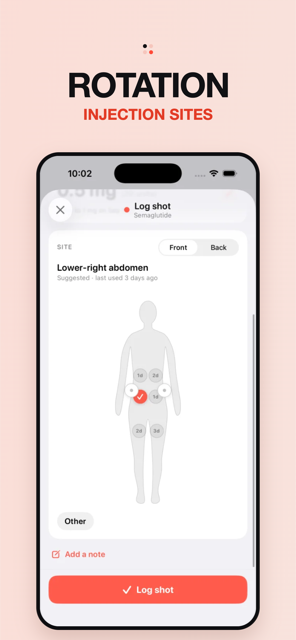
Injection bruising is a small bleed under the skin where the needle went in. The labels fold it into injection site reactions: Zepbound's lists 'injection site bruising' among 6–8% of patients with any site reaction, and Egrifta's tesamorelin label lists 'hemorrhage' inside its 17% figure. Log the site, the shot and a 1–5 score so a body-map log shows whether one spot keeps bruising.
Injection bruising: what it is and who reports it
Injection bruising is the purple or yellow mark that shows up a day or two after a shot. The needle nicked a small vessel under the skin, a little blood leaked into the tissue, and the body is clearing it. It is mechanical, not immune. That is why Peppy tracks bruising as its own item, separate from injection site reaction, which covers redness, itching and swelling.
No GLP-1 label gives a bruising rate on its own. It sits inside the injection site reaction figures:
| Label | Injection site reactions (drug) | Placebo | Bruising named? |
|---|---|---|---|
| Wegovy 2.4 mg | 1.4% | 1% | No, listed as a group |
| Mounjaro | 3.2% | 0.4% | No, listed as a group |
| Zepbound 5 / 10 / 15 mg | 6% / 8% / 8% | 2% | Yes, "injection site bruising" |
| Saxenda (daily) | 13.9% | 10.5% | No; erythema, pruritus, rash named |
| Egrifta SV (tesamorelin, daily) | 17% | 6% | Yes, as "hemorrhage" |
Zepbound's label spells out the types as "injection site bruising, injection site erythema, injection site pruritus, injection site pain, injection site rash". Egrifta's tesamorelin label lists "erythema, pruritus, rash, urticaria, pain, swelling, irritation, hemorrhage". Those are the only two places on a label where the bruise gets its own word.
For research compounds like BPC-157, TB-500 and CJC-1295 / Ipamorelin there is no label and no figure. Many people report that a daily reconstituted peptide bruises more often than a weekly pen, which fits the simplest explanation: more needles, more chances. Whether the insulin syringe, the angle or the site matters more is something only your own log can tell you.
When it tends to show up
Bruising is not tied to dose escalation the way nausea is. It is tied to the individual shot. Many people report a mark that appears within a day, darkens on day two or three, and fades over a week or so. A weekly GLP-1 user can therefore have a bruise from last week's shot still visible on this week's shot day, which is one reason the labels insist on moving around.
The labels are consistent about rotation. Mounjaro's says "Rotate injection sites with each dose." Ozempic's says to "use a different injection site each week when injecting in the same body region." Saxenda's says to "rotate injection sites within the same region". None of them is written specifically about bruising, but they all point the same way: the pattern worth finding is site-specific. Does the left thigh bruise while the abdomen does not? Does a fresh vial or a new batch of syringes change anything? The injection site rotation guide covers the 13 sites Peppy uses and how it suggests the next one.
What is worth logging
- The site, every shot. Not "leg" but which thigh. Without this, a bruising log is just a list of dates.
- A 1–5 score, the day after. Bruises show late, so score them in the next day's check-in rather than on shot day. A 1 is a pinprick mark; a 5 is a bruise you would show someone.
- Which protocol. If you run more than one compound, the bruise may follow one of them, or follow the syringe size you use for it. Peppy colour-codes each protocol on the calendar so you can tell them apart.
- A one-line note. "Hit a vessel, bled a drop", "new syringe box", "injected cold from the fridge". You are giving future-you context, not diagnosing.
- A dated photo (Pro). A bruise is easier to show than describe. Progress photos in Peppy stay on your device and in your iCloud.
If you also get redness or a lump at the same spot, score that under injection site reaction. Keeping the two separate is what lets you see later that one site bruises while another itches.
When to contact your prescriber
This is a tracking page, not a treatment page. The labels do not set a threshold for bruising, so the judgement calls below are the ones a real person would make.
- A bruise that keeps growing after day two, or a hard, painful lump under it. A small bleed should stabilise quickly. One that does not is a same-day call.
- Bleeding that does not stop with light pressure, or bruises appearing away from any injection site. Tell your prescriber, and mention any blood thinner or supplement you take.
- Bruising at every shot, or getting worse over weeks. Bring the site log. Whoever taught you to inject can look at angle, depth and site choice with actual data in front of them.
- Hives, facial swelling or trouble breathing are hypersensitivity, not bruising, and are an emergency. The Zepbound label lists hypersensitivity reactions separately at 5% versus 3%.
How to do this in Peppy
- Turn bruising on. Open Settings ▸ Tracking and toggle Bruising. It is not one of the GLP-1 defaults, so it is off until you add it. You can track up to 28 side effects.
- Log every shot on the body map. Tap the dose on the Today tab. The Log shot sheet shows a front/back silhouette with 13 sites; Peppy marks the one it suggests and shows "Last used 6 days ago" on the others. Tap the site you actually used, adjust the time if needed, add a note, save.
- Score it the next day. In the daily check-in on the Today tab, set bruising from 1 to 5 and describe the mark in the note. If the same spot is red or itchy, score injection site reaction too.
- Compare against the site heat-map (Pro). In a protocol's rotation settings, Peppy shows how often each site has been used and lets you set a custom rotation order. A site that is used most and bruises most is the finding.
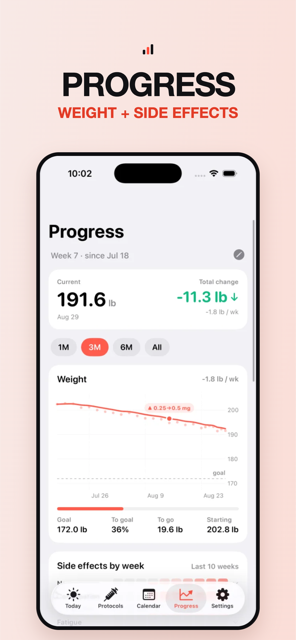
- Read the weekly heat-map in Progress (Pro). The bruising row shows whether marks cluster around a new vial, a new syringe box or a change in dose. Free users see the chart blurred.
- Use the Calendar to match a bruise to a shot. Tap the day, see the shot, its site and the protocol colour, and you know exactly which injection left the mark.
Related: injection site reaction, flushing, the BPC-157 tracker and the side-effects tracking guide.

Track it in Peppy
123 compounds built in, the units math done for you, body-map site rotation and reminders — private on your iPhone.
 Free · iPhone · no account
Frequently asked
Why do I bruise after my Ozempic or Wegovy shot?
A bruise means the needle nicked a small blood vessel under the skin. The labels do not give a separate bruising rate; Wegovy lists injection site reactions in 1.4% of patients and Zepbound in 6–8%, with bruising named as one of the types. Many people report it comes and goes with the site and the technique rather than the dose.
Is bruising a sign I injected wrong?
Not necessarily. Small vessels sit everywhere under the skin and occasional bruising happens with good technique. What the labels do say is to rotate: Mounjaro's says to rotate injection sites with each dose, Ozempic's to use a different site each week in the same body region. A site that bruises every time is worth a conversation with whoever taught you to inject.
Do peptide injections bruise more than GLP-1 pens?
There is no label for research compounds like BPC-157 or TB-500, so no figure exists. Egrifta SV (tesamorelin), a daily reconstituted peptide with a label, lists injection site reactions including hemorrhage in 17% of patients versus 6% on placebo. Many people report that daily shots simply give more chances to bruise than weekly ones.
Which injection site bruises the least?
It varies by person and there is no label answer. Many people report the abdomen bruises less than the thigh, others the opposite. Logging the site on every shot and scoring bruising the next day is the only way to find your own answer.
When should I worry about bruising from injections?
A coin-sized bruise that fades over a week is what most people describe. A bruise that keeps growing, a hard painful lump, bleeding that does not stop, or bruises appearing away from the injection sites are reasons to contact your prescriber, especially if you take a blood thinner.
Sources
- Zepbound prescribing information — Eli Lilly (DailyMed)
- Egrifta SV (tesamorelin) prescribing information — Theratechnologies (DailyMed)
- Mounjaro prescribing information — Eli Lilly (DailyMed)
- Ozempic prescribing information — Novo Nordisk (DailyMed)
- Wegovy prescribing information — Novo Nordisk (DailyMed)
- Saxenda prescribing information — Novo Nordisk (DailyMed)
Not medical advice. Peppy is a tracking tool, not medical advice. Dose calculations are mathematical conversions only. Always follow your prescriber's instructions and verify every draw-up yourself.