Sulfur burps on GLP-1s: what to track, when they tend to show up, and how to log them
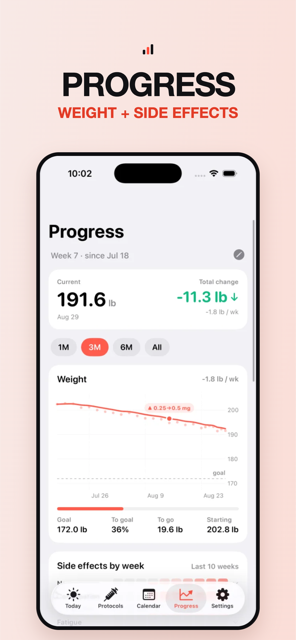
Sulfur burps are rotten-egg-smelling belches that many GLP-1 users report. The labels call it eructation: Wegovy lists it in 7% of participants versus under 1% on placebo, Zepbound 4–5%, Saxenda 4.5%, Ozempic 2.7% at 0.5 mg. Log a daily 1–5 score with what you ate, and compare against shot days and step-ups in a weekly heat-map.
Sulfur burps on GLP-1s: what they are and who reports them
Sulfur burps are belches that smell like rotten eggs. They are one of the most-searched GLP-1 side effects and one of the least-documented, because no label uses the phrase. What the labels list is "eructation", the clinical word for belching, and that is the number you have to work with.
| Label | Eructation (drug) | Eructation (placebo) |
|---|---|---|
| Wegovy 2.4 mg | 7% | <1% |
| Zepbound 5 / 10 / 15 mg | 4% / 5% / 5% | 1% |
| Saxenda | 4.5% | 0.2% |
| Ozempic 0.5 / 1 mg | 2.7% / 1.1% | 0% |
Mounjaro's label does not list eructation among its tabulated reactions. Semaglutide (Ozempic, Wegovy, compounded semaglutide) and tirzepatide (Mounjaro, Zepbound, compounded tirzepatide) both slow gastric emptying, and many people report the sulfur smell as the thing that makes GLP-1 belching different from ordinary belching. The label does not separate the two, so treat the figures above as an upper bound for the specific rotten-egg version, not a count of it.
Peppy tracks sulfur burps and plain belching as separate side effects for exactly this reason. If you only get the ordinary kind, use that one.
When they tend to show up
The labels put gastrointestinal reactions as a group "most frequently" in dose-escalation weeks (Wegovy), occurring mostly "during dose escalation" and decreasing over time (Zepbound). Beyond that, the label is silent, and what remains is what people report.
Three patterns come up often. Many people say sulfur burps are worst in the day or two after a weekly shot, alongside nausea. Many say they are tied to specific meals, especially large or high-fat ones, which makes sense if food is sitting in the stomach longer. And many say they flare for a week or two after each step-up and then quieten. None of that is on the label. All of it is checkable in your own log within a month.
If you are on Wegovy, the label's escalation schedule moves every four weeks through 0.25 mg, 0.5 mg, 1 mg and 1.7 mg before 2.4 mg. If you are on Zepbound, it starts at 2.5 mg for four weeks and rises in 2.5 mg increments after at least four weeks on a dose. Those step dates are the ones to circle.
What is worth logging
- Severity, 1–5, daily. Score frequency and smell together; a couple of mild burps is a 1 or 2, a day you could not be in a meeting is a 5.
- What you ate. This is the one side effect where the food note matters most. Keep it to a few words: "eggs at breakfast", "big dinner late", "skipped lunch".
- Days since the shot. Log the shot in the same app so the offset is automatic.
- Whether nausea or heartburn came with it. Sulfur burps rarely arrive alone in people's logs. Tracking nausea and heartburn alongside shows whether they move together.
Skip anything that turns this into a diet diary. A food note is context, not a calorie count, and Peppy does not do food logging by design.
When to contact your prescriber
Eructation is not flagged as a warning sign on any GLP-1 label. The things that are flagged, and that sometimes travel with it, are worth quoting.
- "Persistent or severe abdominal pain (sometimes radiating to the back), and which may or may not be accompanied by nausea or vomiting." This is the pancreatitis language on the Wegovy, Ozempic, Mounjaro, Zepbound and Saxenda labels.
- Vomiting that leads to dehydration. The labels link dehydration from GI reactions to acute kidney injury.
- Burps with a change in kind. A new pain, a swollen belly, or a smell that arrives with vomiting is not a burp problem. Call.
If sulfur burps are affecting your work or sleep even without red flags, that is still worth raising. The labels say to consider delaying escalation if a dose is not tolerated, and your prescriber cannot weigh that without knowing.
How to do this in Peppy
- Confirm sulfur burps is on. It is a GLP-1 default alongside nausea, constipation, heartburn and food noise. If it is missing, go to Settings ▸ Tracking and toggle it on. Belching is a separate toggle if you want both.
- Log a daily check-in. Tap the check-in row on the Today tab. Score sulfur burps 1–5, then type the food note. Weight goes in the same sheet and syncs to Apple Health.
- Log every shot with the body map. Tap the dose on the Today tab, tap the site on the front/back silhouette, and save. Peppy stores the time and dose so every check-in has a "days since shot" behind it.
- Open Progress (Pro) for the weekly heat-map. Each side effect is a row of weekly cells with your titration step-ups marked on the same axis. If the sulfur burps row darkens for a week or two after each marker and then lightens, you have found your pattern. On the free tier the chart is blurred.
- Use the Calendar for shot-day detail. The week strip shows which days were shot days, so you can flip between check-ins and see whether the worst scores cluster on days one to three.
The side-effects tracking guide covers the full check-in setup. See also the Wegovy tracker and Mounjaro tracker pages.

Track it in Peppy
123 compounds built in, the units math done for you, body-map site rotation and reminders — private on your iPhone.
 Free · iPhone · no account
Frequently asked
Why do GLP-1s cause sulfur burps?
GLP-1 medicines slow gastric emptying, so food sits in the stomach longer. The labels do not explain the smell; they simply list eructation (belching) as an adverse reaction. Many people report the sulfur smell tracks with certain meals, which is why a food note next to the score is useful.
How common are sulfur burps on Wegovy?
Wegovy's label lists eructation in 7% of participants versus less than 1% on placebo. It does not separate sulfur-smelling burps from ordinary belching, so the real number for the specific rotten-egg version is not on the label.
Do sulfur burps go away?
The labels say gastrointestinal reactions in general cluster around dose escalation and decrease over time, but they do not give a duration for eructation. Many people report it comes and goes with dose changes and particular foods rather than fading on a fixed schedule.
Are sulfur burps a sign of something serious?
The labels do not list eructation as a red flag on its own. The warning language to know is persistent or severe abdominal pain, sometimes radiating to the back, with or without nausea or vomiting. If burps arrive with that kind of pain, or with vomiting, contact your prescriber.
How do I track sulfur burps in an app?
In Peppy, sulfur burps are one of the five GLP-1 default side effects. Score them 1–5 in the daily check-in, add what you ate in the note, and the Progress tab (Pro) shows them week by week next to your dose step-ups.
Sources
Not medical advice. Peppy is a tracking tool, not medical advice. Dose calculations are mathematical conversions only. Always follow your prescriber's instructions and verify every draw-up yourself.