Mood swings on GLP-1s and peptides: what the labels say, what to log, and when to call
Mood swings are not an adverse reaction row on any GLP-1 label. Saxenda lists anxiety at 2% versus 1.6% in adults and depression at 4% versus 2.4% in adolescents; Wegovy lists anxiety at 4% versus 2% in adolescents. The Wegovy, Zepbound and Saxenda labels all show a Suicidal Behavior and Ideation warning removed in February 2026. Any mood change that worries you is a prescriber call, not a tracking question. For everything milder, log mood 1–5 daily next to sleep, appetite and shot days.
GLP-1 mood swings: what the labels say and who reports it
GLP-1 mood swings are the part of the experience the labels say least about. People describe feeling flat, snappy, tearful for no reason, or oddly low in the days after a shot, and the adverse reaction tables for semaglutide (Ozempic, Wegovy) and tirzepatide (Mounjaro, Zepbound) barely touch it. What is there is thin and mostly from the adolescent trials.
| Label | Mood-related row (drug / placebo) |
|---|---|
| Saxenda, adults | anxiety 2% / 1.6% |
| Saxenda, adolescents | depression 4% / 2.4% |
| Wegovy, adolescents | anxiety 4% / 2% |
| Wegovy, adults | none tabulated |
| Ozempic, Mounjaro, Zepbound | none tabulated |
One thing has changed recently and is worth being precise about. The Wegovy, Zepbound and Saxenda labels used to carry a Warnings and Precautions section on suicidal behavior and ideation. The current versions on DailyMed list that section as removed in February 2026, and the current text carries no depression warning. That is a regulatory judgement about the trial and post-marketing evidence. It is not a statement that your mood cannot change, and nothing about it changes the advice at the bottom of this page: new low mood, or any thought of harming yourself, is a same-day call.
Research compounds sit outside all of this. There are no labels, so there are no rates, and the reports people share about mood on them are inconsistent. Peppy tracks mood swings as one side effect across everything you log, GLP-1 or research compound, so at least the record is in one place.
When it tends to show up
The labels give no timing for mood effects. They do give timing for the things that most reliably wreck anyone's mood. Nausea, vomiting and reduced eating cluster during dose escalation and in the days after each shot. Saxenda's label says fatigue, malaise and dizziness were mainly reported in the first 12 weeks and often together with the stomach reactions. Every label warns about low blood sugar when a GLP-1 is combined with insulin or a sulfonylurea, and shakiness, sweating and irritability are how that tends to feel.
Many people add something the labels do not measure: the emotional side of losing interest in food. When food noise goes quiet, some people feel relief and some feel a loss they did not expect. Add poor sleep, which many report in the first weeks, and a bad-tempered fortnight after a step-up starts to look less mysterious. None of that is a diagnosis. It is a list of things to log so you and your prescriber can see which of them lines up with your mood line.
What is worth logging
- Mood, 1–5, every evening. Peppy's feelings row has mood on by default. Score the day as a whole, not the worst five minutes.
- Mood swings as a side effect on the days the swing is the problem. A flat 2 all week is one thing. A 4 in the morning and a 1 by dinner is what this row is for.
- Sleep and appetite control, in the same check-in. Both are on by default in feelings. They are the two most common explanations people find in their own logs.
- What happened, in the note. "Skipped two meals", "slept four hours", "cried at nothing". Context, not a diary.
- Days since your shot and the dose. Log shots in the same app and the offset and step-up dates come free.
- Insomnia, fatigue and low blood sugar alongside. See insomnia, fatigue and low blood sugar. Rows that darken together are a pattern your prescriber can work with.
When to contact your prescriber
Most mood changes people describe on GLP-1s are mild and settle. Some are not a tracking question at all.
- Any thought of harming yourself, or of not wanting to be here. Stop reading this page and contact your prescriber, a crisis line or emergency services today. In the US you can call or text 988.
- Low mood that is new since starting and is not lifting. Two weeks of a 1 or 2 on the mood line is a reason to book an appointment, with the log in hand.
- A history of depression or anxiety. Tell your prescriber before you start if you have not, and tell them early if things shift. They may want a closer check-in schedule.
- Shakiness, sweating, confusion or a racing heart with the irritability, especially on insulin or a sulfonylurea. That is the low blood sugar warning on every label, and it needs a same-day call.
- Mood changes on a research compound. With no label to lean on, do not wait for a pattern. A clinician is the right person to hear about it.
- A step-up that clearly made things worse. The labels say to consider delaying escalation when a dose is not tolerated. That decision is your prescriber's, and it is an easier one with a chart.
How to do this in Peppy
- Check the feelings row. Mood, sleep, energy and appetite control are on by default. Open Settings ▸ Tracking to confirm, and toggle Mood swings under side effects so the swings themselves get their own row. Insomnia is in the same list.
- Score it in the daily check-in. On the Today tab tap the check-in row. Set mood 1–5 in feelings, set mood swings 1–5 on the days it applies, write the note, add weight if you weighed in. The check-in counts toward your streak.
- Log shots with the body map. Tap the dose on the Today tab, tap the site on the silhouette, confirm the time. The dose you were on is saved with it, so a titration ladder (Pro) becomes step-up markers on your charts.
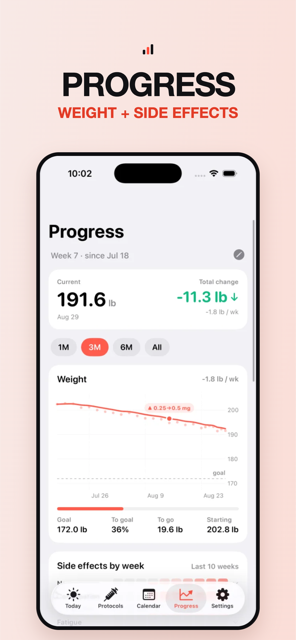
- Read the feelings chart and the heat-map together in Progress (Pro). Mood, sleep and appetite control sit on one time axis with step-ups marked; the side-effect heat-map underneath shows mood swings, nausea and insomnia as rows. A mood dip that follows every step-up by three days is one story. A mood dip that follows every bad-sleep night is another. The free tier shows the chart blurred.
- Set a check-in reminder (Pro). Settings ▸ Reminders ▸ Check-in at the same time each evening keeps the mood line honest on the days you least feel like logging.
- Export before an appointment (Pro). Settings ▸ Export produces a PDF or CSV of doses and check-ins. Peppy never sends it anywhere itself. The export guide covers what is in it.
Related: the side-effects tracking guide, the Wegovy tracker and the Zepbound tracker pages.

Track it in Peppy
123 compounds built in, the units math done for you, body-map site rotation and reminders — private on your iPhone.
 Free · iPhone · no account
Frequently asked
Do GLP-1s cause mood swings?
The labels do not list mood swings. Saxenda's label lists anxiety in 2% of adults versus 1.6% on placebo and depression in 4% of adolescents versus 2.4%. Wegovy's lists anxiety in 4% of adolescents versus 2%. Ozempic, Mounjaro and Zepbound list no mood-related adverse reactions. Many people still report feeling flatter, more irritable or more tearful, especially in the first weeks and after step-ups.
Is there a depression or suicidal thoughts warning on Wegovy or Zepbound?
Not on the current labels. The Wegovy, Zepbound and Saxenda prescribing information on DailyMed each list a Suicidal Behavior and Ideation warning as removed in February 2026, and the current text carries no depression warning. That is a change in the label, not a statement that mood cannot be affected. New or worsening low mood, or any thoughts of self-harm, are a same-day call to your prescriber or a crisis line.
Why do I feel irritable on my GLP-1?
The labels do not say. The things they do describe, nausea, eating much less, poor sleep, and in some people low blood sugar, are all things that make most people irritable. Many people also report that losing the pleasure of food, the quiet that replaces food noise, takes emotional adjusting. A log that lines mood up with sleep, appetite and shot days shows which of these is yours.
Do research peptides cause mood changes?
There are no labels for research compounds, so there are no rates. Many people report mood effects with some of them and none with others, and the reports are inconsistent. Treat any mood change on a research compound as unexplained, log it with the same care, and talk to a clinician rather than to a forum.
How should I track GLP-1 mood swings?
Score mood 1–5 every evening in the feelings row, which Peppy has on by default, and add the mood-swings side effect for days the swing itself is the problem. Log sleep and appetite control alongside, keep shots in the same app, and read the four lines together in Progress.
Sources
Not medical advice. Peppy is a tracking tool, not medical advice. Dose calculations are mathematical conversions only. Always follow your prescriber's instructions and verify every draw-up yourself.