Low blood sugar on GLP-1s: what the labels say, who it mostly affects, and how to log it
On their own, GLP-1s rarely cause low blood sugar. Ozempic's label lists documented symptomatic hypoglycemia at 1.6% and 3.8% as monotherapy, rising to 16.7% and 29.8% when added to basal insulin. Wegovy lists 6% vs 2% in people with type 2 diabetes; Zepbound 4.2% vs 1.3%. Every label warns the risk goes up with insulin or a sulfonylurea. Log shaky, sweaty or foggy episodes with the time and what you ate.
GLP-1 low blood sugar: what it is and who reports it
GLP-1 low blood sugar is the shaky, sweaty, suddenly starving spell that can turn up mid-morning or after a skipped meal. The medical word is hypoglycemia, and on the labels it has a clear shape: uncommon when semaglutide (Ozempic, Wegovy) or tirzepatide (Mounjaro, Zepbound) is used alone, and a real risk when it is combined with insulin or a sulfonylurea. The labels are careful to say the GLP-1 is not usually the whole story; it is the combination.
| Label | Alone | With insulin or sulfonylurea |
|---|---|---|
| Ozempic 0.5 / 1 mg | 1.6% / 3.8% vs 0% (symptomatic, 70 mg/dL or below) | 16.7% / 29.8% vs 15.2% with basal insulin |
| Mounjaro 5 / 10 / 15 mg | 0–1% (under 54 mg/dL) | 16% / 19% / 14% vs 13% with basal insulin |
| Wegovy 2.4 mg | 6% vs 2% in people with type 2 diabetes | risk "increased" with insulin or secretagogue |
| Zepbound 5–15 mg | 0.3% vs 0% without T2D; 4.2% vs 1.3% with T2D (under 54 mg/dL) | risk "may increase" |
| Saxenda | 1.6% vs 1.1% without T2D; 12.6% vs 6.6% with T2D | 28.2% vs 12.7% on a sulfonylurea |
Two things are worth noticing in that table. The "alone" numbers are low, and the definitions differ from label to label (70 mg/dL on Ozempic, 54 mg/dL on Mounjaro and Zepbound), so you cannot line them up as a ranking. And every combination column jumps. If you take insulin or a sulfonylurea, this page is about you; if you do not, the labels suggest most of what you feel is something else, and a log helps you find out what. Compounded Compounded Semaglutide and Compounded Tirzepatide have no label; the branded numbers are your reference.
When it tends to show up
The labels do not time hypoglycemia the way they time nausea. There is no "most common during escalation" sentence for it. What they say instead is about combinations: Ozempic's label says the risk "may be lowered by a reduction in the dose of sulfonylurea", and Zepbound's says reducing the insulin or sulfonylurea dose "may be necessary". Those are prescriber decisions, and they tend to come up right after a GLP-1 is started or stepped up, when the other medicine has not been adjusted yet.
What people report fills in the timing. Many say the spells come late morning or mid-afternoon on days they ate very little, which on a GLP-1 is most days in the first months. Many say they cluster in the two or three days after a shot, when appetite is lowest. And many, once they start checking with a meter, find their "lows" were a normal reading plus an empty stomach. That last group is large, which is why the log needs a food note and, if you have one, the number.
What is worth logging
- Severity, 1–5, on the day it happens. 1 is a brief wobble, 5 is an episode you needed help with or had to stop and treat.
- The time and what you had eaten. "11am, coffee only" versus "3pm, two hours after lunch" is the whole diagnostic question.
- The meter reading, if you have one. Write it in the note. A symptom with a number beside it is what your prescriber wants to see.
- Your other medicines. If you are on insulin or a sulfonylurea, note any dose change your prescriber makes and the date. The effect on the score should be visible within days.
- Days since your shot and the dose you were on. Log shots in the same app and both are automatic.
- Dizziness, fatigue and hunger alongside. They overlap heavily. See dizziness, fatigue and increased hunger.
When to contact your prescriber
Hypoglycemia has a clearer threshold than most side effects on this site.
- Any severe episode. The labels define severe hypoglycemia as needing another person's assistance. Loss of consciousness or a seizure is an emergency, not a call.
- Repeated readings under 70 mg/dL, or symptoms that keep returning. Call the same week, and mention every glucose-lowering medicine you take. The labels put the fix on the insulin or sulfonylurea side, and that is not something to adjust yourself.
- Spells that started after a step-up. Bring the dates. The titration markers in your log make this a one-minute conversation.
- Spells with no food for hours beforehand and a normal reading. Still worth mentioning, because the answer may be about eating pattern rather than medicine, and a prescriber can tell the difference faster with a log.
How to do this in Peppy
- Turn low blood sugar on. It is not one of the five GLP-1 defaults. Open Settings ▸ Tracking and toggle Low blood sugar. Dizziness and Fatigue are in the same list.
- Score it in the daily check-in. On the Today tab tap the check-in row. Set low blood sugar 1–5, put the time, the meter reading and the food note in the notes field. Appetite control is one of the default feelings; score that too. The check-in counts toward your streak.
- Log shots with the body map. Tap the dose on the Today tab, tap the site on the silhouette, confirm the time. The dose you were on is saved with the shot, so your titration ladder (Pro) turns into step-up markers on the charts.
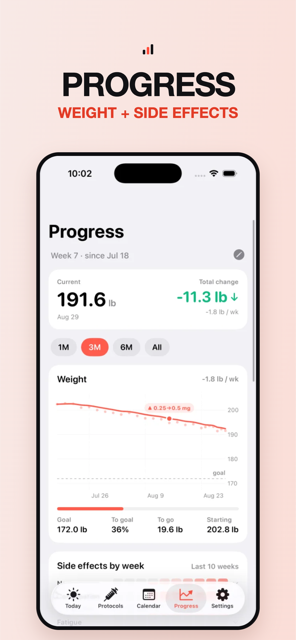
- Read the heat-map in Progress (Pro). The low blood sugar row sits with dizziness and fatigue on one week axis. A row that lights up in the two days after each shot reads differently from one that lights up on random weekdays. The free tier shows the chart blurred.
- Use the Calendar for the shot-day question. The week strip shows shot days. Flip through check-ins and compare the days right after a shot with the days before the next one.
- Export before an appointment (Pro). Settings ▸ Export produces a PDF or CSV of doses and check-ins with your notes, including the meter readings you typed. The export guide covers what is in it.
Related: the side-effects tracking guide, the Ozempic tracker and the Mounjaro tracker pages.

Track it in Peppy
123 compounds built in, the units math done for you, body-map site rotation and reminders — private on your iPhone.
 Free · iPhone · no account
Frequently asked
Does Ozempic cause low blood sugar?
Rarely on its own. Ozempic's label lists documented symptomatic hypoglycemia (glucose 70 mg/dL or below) at 0%, 1.6% and 3.8% for placebo, 0.5 mg and 1 mg as monotherapy, with no severe events. Added to basal insulin the same measure was 15.2%, 16.7% and 29.8%. The label says the risk may be lowered by reducing the sulfonylurea dose, which is your prescriber's call.
Can you get GLP-1 low blood sugar without diabetes?
The labels say it is uncommon. Zepbound's label reports glucose under 54 mg/dL in 0.3% of treated patients without type 2 diabetes versus none on placebo. Saxenda's reports spontaneously reported symptomatic episodes in 1.6% of treated patients versus 1.1% on placebo. Many people report shaky, hungry spells that turn out to be under-eating rather than true hypoglycemia, which is why the food note matters.
What does low blood sugar feel like on a GLP-1?
The labels do not give a symptom list. Commonly recognised signs are shakiness, sweating, a racing heart, sudden hunger, confusion and irritability. If you have a glucose meter, a reading at the time is worth more than any description; write the number in the note.
Is hypoglycemia worse on Mounjaro with insulin?
Mounjaro's label shows glucose under 54 mg/dL in 0 to 1% of patients as monotherapy, but 16%, 19% and 14% at 5, 10 and 15 mg when added to basal insulin, versus 13% on placebo plus insulin. The label warns that combining with insulin or an insulin secretagogue may increase the risk, including severe hypoglycemia.
When is low blood sugar on a GLP-1 an emergency?
Any episode where you needed someone else's help, lost consciousness or had a seizure is what the labels call severe hypoglycemia and needs urgent care. Repeated readings under 70 mg/dL, or symptoms that keep returning, are a same-week call to your prescriber, especially if you also take insulin or a sulfonylurea.
Sources
Not medical advice. Peppy is a tracking tool, not medical advice. Dose calculations are mathematical conversions only. Always follow your prescriber's instructions and verify every draw-up yourself.