Belching on GLP-1s: what the labels call it, when it shows up, and how to log it
Belching shows up on GLP-1 labels under the word eructation. Wegovy lists it at 7% versus under 1% on placebo, Zepbound 4–5% versus 1%, Saxenda 4.5% versus 0.2%, Mounjaro 2.5–3.3% versus 0.4%, and Ozempic 1.1–2.7% versus 0%. It is rarely serious but it is a useful early signal of slowed digestion. Log frequency 1–5 with a meal note and watch it against shot days.
GLP-1 belching: what it is and who reports it
GLP-1 belching is the burping that starts a few days into semaglutide (Ozempic, Wegovy), tirzepatide (Mounjaro, Zepbound) or liraglutide (Saxenda) and does not quite stop. It is one of the milder things on the list, and one of the more socially annoying. On the labels it goes by "eructation", which is why people searching for burping often miss it.
| Label | Eructation (drug / placebo) |
|---|---|
| Wegovy 2.4 mg | 7% / under 1% |
| Zepbound 5 / 10 / 15 mg | 4% / 5% / 5% vs 1% |
| Saxenda | 4.5% / 0.2% |
| Mounjaro 5 / 10 / 15 mg | 3.0% / 2.5% / 3.3% vs 0.4% |
| Ozempic 0.5 / 1 mg | 2.7% / 1.1% vs 0% |
Two things stand out. The placebo numbers are close to zero, so nearly all of it is the medicine. And the label word covers ordinary air burps only. The rotten-egg version many people describe is not a separate label term, so Peppy tracks belching and sulfur burps as two side effects and lets you score whichever you have. Compounded Compounded Semaglutide and Compounded Tirzepatide have no label; the branded numbers are the reference.
When it tends to show up
The labels do not give belching its own timeline. They talk about gastrointestinal reactions as a group: Wegovy's says they "were most frequently reported during dosage escalation", and Mounjaro's and Zepbound's say most nausea, vomiting and diarrhea "occurred during dose escalation and decreased over time."
What people report is that belching is one of the first things to arrive and one of the more persistent. Many notice it in the first week, often before nausea, and many say it settles into a background level that flares after big meals, carbonated drinks, or the two or three days after a shot. Some find it steps up for a week or two after each dose increase and then fades again.
Because it is mild, it is also easy to shrug off. That is a waste of a signal. Belching often moves with heartburn and indigestion, and a belching row that darkens a day or two before the heartburn row is the kind of thing you only see in a log.
What is worth logging
- Frequency, 1–5, daily. A 1 is a few extra burps; a 5 is constant and noticeable to other people. Score the whole day, not one moment.
- Smell. If it is sulfurous, score sulfur burps instead of, or as well as, belching. They are separate rows in Peppy.
- Meal and drink note. "Fizzy drink", "big lunch", "ate fast" is enough. You are leaving context, not counting anything.
- Days since your shot. Log the shot in the same app and the offset is automatic.
- The dose you were on. A step-up flare and a steady-dose baseline are two different numbers.
- Heartburn and nausea alongside. They tend to travel together, and the pattern is more useful than any one row.
When to contact your prescriber
Belching is not a red-flag reaction on any GLP-1 label. Some things near it are.
- "Persistent or severe abdominal pain (sometimes radiating to the back), and which may or may not be accompanied by nausea or vomiting." This is the pancreatitis warning on every GLP-1 label. Belching with that kind of pain is not a burping problem.
- Belching with repeated vomiting. The labels tie vomiting-driven dehydration to reports of acute kidney injury. See vomiting.
- Belching that has become daily reflux or chest discomfort. Chest pain that is not obviously digestive is an emergency, not a log entry.
- A flare that is not settling after a step-up. The labels say to consider delaying escalation if a dose is not tolerated. That is your prescriber's call; the log makes it a short conversation.
How to do this in Peppy
- Turn belching on. Sulfur burps is a GLP-1 default; plain belching is not. Open Settings ▸ Tracking and toggle Belching. Heartburn and Indigestion are in the same list.
- Score it in the daily check-in. On the Today tab tap the check-in row. Set belching 1–5, add the meal note, add weight if you weighed in. The check-in counts toward your streak.
- Log shots with the body map. Tap the dose on the Today tab, tap the site on the silhouette, confirm the time. The dose is saved with the shot, so your titration ladder (Pro) turns into step-up markers on the charts.
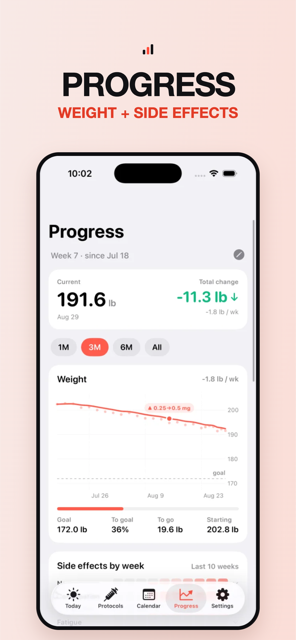
- Read the heat-map in Progress (Pro). The belching row sits with sulfur burps and heartburn on one week axis, step-ups marked. If belching darkens first and heartburn follows, you have an early-warning row. The free tier shows the chart blurred.
- Use the Calendar for the meal-versus-shot question. The week strip shows shot days. Flip through check-ins and compare day one after a shot with day six. If the notes say "fizzy drink" on every bad day, that is your answer.
- Export before an appointment (Pro). Settings ▸ Export produces a PDF or CSV of doses and check-ins. The export guide covers what is in it.
Related: the side-effects tracking guide, the Wegovy tracker and the Zepbound tracker pages.

Track it in Peppy
123 compounds built in, the units math done for you, body-map site rotation and reminders — private on your iPhone.
 Free · iPhone · no account
Frequently asked
Does Wegovy cause belching?
Yes, and it is the highest on the labels. Wegovy's prescribing information lists eructation in 7% of patients versus less than 1% on placebo. Ozempic, the lower-dose semaglutide, lists 2.7% at 0.5 mg and 1.1% at 1 mg versus 0%.
Why do GLP-1 medications cause burping?
The labels do not explain eructation specifically. GLP-1 medicines slow gastric emptying, and many people report that food and swallowed air sitting longer in the stomach is what seems to produce the burping, especially after larger meals or fizzy drinks.
Is GLP-1 belching the same as sulfur burps?
Not quite. Plain belching is air. Sulfur burps have a rotten-egg smell and many people report them as a separate, more disruptive problem. The labels only list eructation, so Peppy tracks belching and sulfur burps as separate side effects and lets you score each.
Does belching on tirzepatide get worse at higher doses?
Slightly, on the trial averages. Zepbound's label lists eructation at 4%, 5% and 5% for 5, 10 and 15 mg versus 1% on placebo. Mounjaro's lists 3.0%, 2.5% and 3.3% versus 0.4%. These are population numbers, not a dose-response you can apply to yourself.
When is belching on a GLP-1 a reason to call the doctor?
Belching itself is not flagged on any label. What the labels do flag is persistent, severe abdominal pain that may radiate to the back, with or without nausea or vomiting, as possible pancreatitis. Belching with that kind of pain, or belching that arrives with repeated vomiting, is worth a call.
Sources
Not medical advice. Peppy is a tracking tool, not medical advice. Dose calculations are mathematical conversions only. Always follow your prescriber's instructions and verify every draw-up yourself.