Water retention on growth hormone peptides: what to track, when it shows up, and how to log it
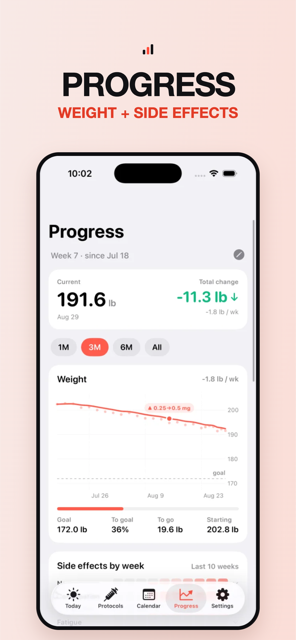
Water retention is the puffiness, tight rings and swollen ankles many people report on growth hormone secretagogues like ipamorelin, CJC-1295, sermorelin and MK-677. The only label in this group, Egrifta (tesamorelin), lists peripheral edema at 6% versus 2% on placebo and links it to fluid retention from GH release. Log a 1–5 score with morning weight and line it up against shot days and dose changes.
Peptide water retention: what it is and who reports it
Peptide water retention is fluid held in the tissue rather than fat gained. Rings feel tight in the morning, socks leave a line, the face looks a little fuller, and the scale jumps a pound or two in a couple of days. It is reported most with the growth hormone secretagogues: Ipamorelin, CJC-1295 / Ipamorelin, CJC-1295 (with DAC), Sermorelin, Tesamorelin and the oral compound MK-677. It is not a GLP-1 side effect; if anything, semaglutide and tirzepatide users describe the opposite as intake drops.
Only one compound in this group has a current FDA label. Egrifta SV (tesamorelin) lists peripheral edema in 6% of patients versus 2% on placebo over 26 weeks. Its warnings section is the clearest statement of the mechanism anywhere on a label: "Fluid retention may occur during EGRIFTA SV therapy and is thought to be related to the induction of GH secretion. This manifests as increased tissue turgor and musculoskeletal discomfort resulting in adverse reactions (e.g. edema, arthralgia, and carpal tunnel syndrome) which are either transient or resolve with discontinuation of treatment."
Ipamorelin, CJC-1295, MK-677 and the GHRPs are research compounds with no label and no rate. Sermorelin was once a prescription product but no current prescribing information is on DailyMed. So for most of this group the honest statement is qualitative: many people report it, it is usually mild, and the tesamorelin label gives a plausible reason why. Peppy flags water retention as common for peptides in general for that reason.
When it tends to show up
Many people report water retention in the first one to three weeks after starting a GH secretagogue, and again for a week or so after each dose increase. Some describe it fading on its own as the body adjusts; the Egrifta label's "transient" fits that. Others report it holds steady for as long as they are on the compound and clears within days of a break.
Timing within the day matters too. Many people describe it worst on waking, since GH secretagogues are often taken at night and fluid settles overnight. Hands and face in the morning, ankles by evening, is a common description. Salt, alcohol and a long flight all move the same needle, which is why the note field earns its keep.
If you run cycles, the on/off boundary is the natural experiment. Puffiness that eases in the off block and returns in the on block is a pattern you can show someone. The peptide cycle tracker guide covers setting those up.
What is worth logging
- Severity, 1–5, every morning. A 1 is a ring that is slightly snug; a 5 is visible ankle swelling or a face that looks different in the mirror. Score at the same time daily.
- Morning weight, same scale, same conditions. Fluid shows up as a fast rise that plateaus. Fat does not move a pound overnight. Peppy reads and writes weight with Apple Health, so a smart scale fills this in.
- Days since your last shot and the dose you were on. Log the shot in the same app and the offset is automatic.
- Salt, alcohol, travel, in the note. "Ramen night", "flight", "hot day" are enough to explain an outlier later.
- Joint pain and tingling alongside. The Egrifta label groups edema, arthralgia and carpal tunnel under the same fluid retention heading. If they move together in your log, that is the label's pattern.
- A dated photo (Pro). Puffiness is easier to compare than describe. Progress photos stay on your device and in your iCloud.
When to contact your prescriber
Mild, symmetrical puffiness that comes and goes is what most people describe. Some things near it are not tracking questions.
- Swelling in one leg only, especially with pain, warmth or redness. That is not fluid retention from a peptide and needs a same-day call.
- Swelling with shortness of breath, chest pain, or trouble lying flat. Treat it as an emergency.
- Rapid weight gain over a few days, or swelling that keeps building rather than plateauing.
- Numb or tingling hands with the puffiness. The Egrifta label names carpal tunnel syndrome as one of the fluid retention reactions. Bring the log; the label says these resolve with discontinuation, and that decision is your prescriber's.
- Anything you are taking a diuretic or a heart medicine for. A new source of fluid retention is something that prescriber wants to know about.
How to do this in Peppy
- Turn water retention on. Open Settings ▸ Tracking and toggle Water retention. It is not one of the GLP-1 defaults, so it is off until you add it. Add Joint pain and Numbness / tingling in the same list if you want the label's trio side by side.
- Weigh in and score it in the daily check-in. On the Today tab tap the check-in row. Enter or accept the Apple Health weight, set water retention 1–5, write the salt-or-travel note. The check-in counts toward your streak.
- Log every shot on the body map. Tap the dose on the Today tab, tap the site on the silhouette, confirm the time. The dose is saved with the shot, so any step-up in your titration ladder (Pro) becomes a marker on your charts.
- Set up cycles if you run them (Pro). In the protocol editor, add an on/off block such as 5 on / 2 off. Off days auto-skip, and the boundary is visible on the Calendar so you can compare scores either side of it.
- Read the weight trend and heat-map together in Progress (Pro). The weight chart shows step-up markers; the water retention row sits under it on the same week axis. A weight bump that matches a darkening row and then flattens is fluid. Free users see the charts blurred.
- Export before an appointment (Pro). Settings ▸ Export produces a PDF or CSV of doses, weights and check-ins. The export guide covers what is in it.
Related: joint pain, numbness and tingling, the CJC-1295 / ipamorelin tracker and the weight tracking guide.

Track it in Peppy
123 compounds built in, the units math done for you, body-map site rotation and reminders — private on your iPhone.
 Free · iPhone · no account
Frequently asked
Does ipamorelin cause water retention?
Ipamorelin is a research compound with no FDA label, so there is no rate to quote. Many people report puffiness in the hands, face or ankles, especially in the first weeks or after a dose increase. The mechanism the Egrifta label describes for tesamorelin, fluid retention from increased growth hormone, is the usual explanation, but it has not been measured for ipamorelin.
Is peptide water retention the same as weight gain?
Not necessarily. Many people report the scale moves up a pound or two within days of starting a GH peptide and then flattens, which is more consistent with fluid than fat. A morning weight logged alongside a water retention score is the only way to see which you are looking at.
How long does water retention from CJC-1295 or sermorelin last?
There is no label for either. The Egrifta tesamorelin label says fluid retention reactions such as edema and arthralgia are either transient or resolve with discontinuation of treatment. Many people report puffiness easing over a few weeks; a daily score shows whether yours is.
Does MK-677 cause water retention?
MK-677 (ibutamoren) is an oral research compound with no approved label. Water retention is one of the effects people most often report with it, along with increased hunger. No verified rate exists, so treat it as a pattern to log rather than a number to expect.
When is water retention on a peptide a reason to call the doctor?
Swelling in one leg only, swelling with chest pain or shortness of breath, or rapid weight gain over a few days are not tracking questions and need a same-day call or emergency care. The Egrifta label also groups carpal tunnel syndrome with fluid retention, so numb or tingling hands alongside puffiness is worth raising with your prescriber.
Not medical advice. Peppy is a tracking tool, not medical advice. Dose calculations are mathematical conversions only. Always follow your prescriber's instructions and verify every draw-up yourself.