Increased hunger: late-week hunger on GLP-1s, the hunger that comes with GH peptides, and how to log both
Increased hunger is not a listed adverse reaction on any GLP-1 label. On semaglutide or tirzepatide it is mostly appetite returning on days five to seven of the weekly interval, or after a missed dose. On growth-hormone secretagogues it is different: many people report real hunger on ipamorelin, GHRP-6 and MK-677, and a 2008 trial found 67% of MK-677 users reported increased appetite versus 36% on placebo. Score it 1–5 with a time note and line it up against shot days.
Increased hunger: what it is and who reports it
Increased hunger on this site means two quite different things, and Peppy tracks both under one side effect because the logging is the same. The first is the GLP-1 version: you are on semaglutide (Ozempic, Wegovy) or tirzepatide (Mounjaro, Zepbound), appetite has been quiet for weeks, and then it is back. Usually it is back on days five to seven of the weekly interval, or after a missed shot, or slowly over months. No GLP-1 label lists increased hunger as an adverse reaction; the labels are about appetite going down, not up. This is a reported pattern, not a label finding.
The second is the growth-hormone secretagogue version. Ipamorelin, GHRP-6 and the oral compound MK-677 are research compounds that act on the ghrelin receptor, and ghrelin is the hunger hormone. Many people report they get hungry after a shot, often within the hour, and GHRP-6 has the strongest reputation for it. There is no label to cite for any of them. The closest published evidence is a 2008 randomized trial of MK-677 in healthy older adults, which reported increased appetite in 67% of the MK-677 group versus 36% on placebo, and noted that in half of those it returned to normal within three months.
| Compound | What is documented | What people report |
|---|---|---|
| Semaglutide, tirzepatide | Not a listed reaction; labels describe decreased appetite | Hunger returning late in the weekly interval or after a missed dose |
| MK-677 | 67% vs 36% increased appetite in one 2008 trial | Hunger from the first days, easing for many over weeks |
| Ipamorelin, GHRP-6, CJC-1295/ipamorelin | No label, no controlled trial to cite | Hunger soon after a shot, stronger with GHRP-6 |
If you take both a GLP-1 and a GH peptide, the two effects pull in opposite directions, and only a log tied to each shot shows you which one is winning on a given day.
When it tends to show up
On a weekly GLP-1, many people report hunger climbing through the back half of the interval and dropping the day after the next shot. The labels do not describe this. What they do give is the half-life: semaglutide stays in the body for a long time, which is why the active-level guide shows a slow curve rather than a cliff. Late-week hunger is real for many people even though the drug is still there.
The other GLP-1 trigger is a missed shot. Hunger a day or two after a missed dose is widely reported, and the missed-dose guide covers what the labels say about when to take it. Wegovy's rule turns on whether the next scheduled dose is more than two days away.
On GH secretagogues the timing is tighter. Many people report hunger 20 to 60 minutes after a shot, which is why some time their shots before a meal and others deliberately before bed. On MK-677 it is daily from the start and, in the 2008 trial, faded for about half of people within three months. If you run these on a cycle, the on-weeks and off-weeks in your log should look different.
What is worth logging
- Severity, 1–5, daily. Score the strongest hunger of the day, not the average. 1 is a normal appetite, 5 is hunger that changed what you did.
- The time it hit. "40 min after shot", "all evening", "woke up hungry". On a weekly GLP-1, the day of the interval matters more than the clock.
- Whether it was hunger or food noise. They feel different and Peppy tracks them separately. See food noise for the thinking-about-food kind.
- Missed or late shots. Log them as missed, not silently. A hunger spike two days after a gap explains itself.
- Appetite control in feelings. It is one of Peppy's default feelings and gives you a second, softer line to compare against the side-effect score.
- Shaky, sweaty hunger with a meter reading. That is a different symptom. See low blood sugar, especially if you take insulin or a sulfonylurea.
When to contact your prescriber
Hunger is not a red-flag reaction on any label. A few things around it are worth a call.
- Hunger with shakiness, sweating or confusion. The GLP-1 labels warn about hypoglycemia when combined with insulin or a sulfonylurea. Check a meter if you have one and call if it is low or you cannot check.
- Appetite back to baseline for weeks, not days. Whether that changes anything about your treatment is a prescriber decision. Bring the log so the trend is visible rather than remembered.
- Repeated missed doses. If hunger is coming from gaps, the fix is a reminder, not a medicine change, but tell your prescriber about the gaps anyway.
- Hunger on a research peptide that is not settling. There is no label to lean on. A conversation with whoever oversees your use is the right next step.
How to do this in Peppy
- Turn increased hunger on. It is not one of the five GLP-1 defaults. Open Settings ▸ Tracking and toggle Increased hunger. Food noise and Suppressed appetite are in the same list, so you can score both directions.
- Score it in the daily check-in. On the Today tab tap the check-in row. Set increased hunger 1–5, score appetite control under feelings, put the time in the note, and add your weight. The check-in counts toward your streak.
- Log every shot with the body map. Tap the dose on the Today tab, tap the site on the silhouette, confirm the time. If you missed one, mark it missed on the Calendar so the gap shows. The Calendar's week strip then shows shot days and missed days on one line.
- Set a dose reminder (Pro). Settings ▸ Reminders adds the dose reminder and a missed-dose nudge at 30 minutes, 1 hour or 2 hours. The weekly reminder guide covers the setup. Fewer gaps, fewer unexplained hunger spikes.
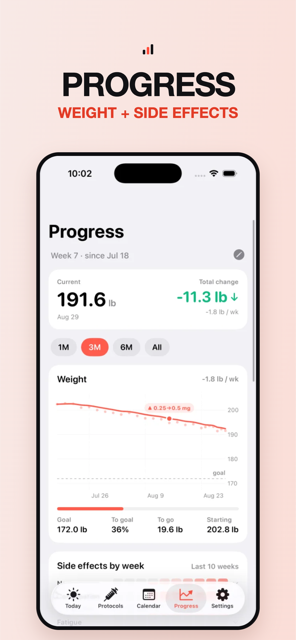
- Read the heat-map in Progress (Pro). The hunger row sits with food noise and suppressed appetite on one week axis. On a weekly GLP-1 you are looking for a row that darkens toward the end of every interval. On a cycled GH peptide, the cycles (Pro) put on and off blocks on the same axis, so hunger in the on-weeks stands out. The free tier shows the chart blurred.
- Export before an appointment (Pro). Settings ▸ Export produces a PDF or CSV of doses, missed doses and check-ins. The export guide covers what is in it.
Related: the side-effects tracking guide, the semaglutide tracker and the CJC-1295/ipamorelin tracker pages.

Track it in Peppy
123 compounds built in, the units math done for you, body-map site rotation and reminders — private on your iPhone.
 Free · iPhone · no account
Frequently asked
Why am I hungry at the end of the week on Ozempic or Wegovy?
Many people report appetite creeping back on days five, six and seven of the weekly interval, before the next shot. The labels do not describe this, and semaglutide's roughly week-long half-life means there is still plenty of drug in your system. Log hunger daily for a month and you will see whether your pattern is a real end-of-week rise or a few noisy days.
Does increased hunger mean my GLP-1 has stopped working?
Not by itself. Appetite drifting up late in the interval, after a missed dose, or as your body adjusts over months is widely reported and is not a label finding of failure. Whether it means anything for your treatment is your prescriber's call. What helps that conversation is a log showing when the hunger comes and whether it tracks with shot timing.
Do ipamorelin and GHRP-6 make you hungry?
Many people report they do, GHRP-6 in particular, often within an hour of a shot. Neither is an approved medicine and there is no label to cite. The best-studied related compound is MK-677, an oral ghrelin mimetic; in a randomized trial in older adults, 67% on MK-677 reported increased appetite versus 36% on placebo, and in half of them it settled within three months.
How do I track increased hunger on a peptide?
Score it 1–5 once a day and put the time of day it hit in the note. Log every shot in the same app so the hours-since-shot offset is automatic. After three or four weeks compare shot-day hunger with off-day hunger, and early-interval with late-interval if you are on a weekly GLP-1.
What if I missed a GLP-1 dose and I am starving?
Hunger after a missed weekly dose is widely reported. Wegovy's label says if a missed dose is more than two days from the next scheduled one, take it as soon as possible; if less than two days, skip it and resume on the regular day. Follow your own label and prescriber, and log the missed dose so the hunger spike has context.
Sources
Not medical advice. Peppy is a tracking tool, not medical advice. Dose calculations are mathematical conversions only. Always follow your prescriber's instructions and verify every draw-up yourself.