Dehydration on GLP-1s: why the labels warn about it, what to watch, and how to log it
Dehydration is not tabulated as an adverse reaction on the GLP-1 labels. It appears in the warnings: Wegovy, Ozempic, Mounjaro, Zepbound and Saxenda all say most reported cases of acute kidney injury occurred in people whose nausea, vomiting or diarrhea led to dehydration. Log fluid intake, thirst, dark urine and dizziness next to your gut symptoms, and watch the days after a shot or a step-up.
GLP-1 dehydration: what it is and who reports it
GLP-1 dehydration is the dry mouth, the headache, the dark urine and the wobble on standing that follows a few days of not eating, not drinking, and losing fluid to vomiting or diarrhea. Semaglutide (Ozempic, Wegovy) and tirzepatide (Mounjaro, Zepbound) do not pull water out of you. They take away the appetite that used to remind you to drink, and in the escalation weeks they can add vomiting and loose stools on top. Dehydration is what those two things add up to.
You will not find it in an adverse-reaction table. None of the five labels tabulates dehydration as a percentage. Where it does appear is the warnings, and the wording is nearly identical across all of them. Wegovy's label, under acute kidney injury: "The majority of the reported events occurred in patients who experienced gastrointestinal adverse reactions leading to dehydration such as nausea, vomiting, or diarrhea." Ozempic, Mounjaro, Zepbound and Saxenda say the same thing in almost the same words.
| Label | Dehydration tabulated? | Where it appears |
|---|---|---|
| Wegovy | No | Acute kidney injury warning |
| Ozempic | No | Acute kidney injury warning |
| Mounjaro | No | Acute kidney injury warning |
| Zepbound | No | Acute kidney injury warning |
| Saxenda | No | Renal impairment warning |
So the label story is short: dehydration is the bridge between the gut effects everyone talks about and a kidney warning most people never read. Compounded Compounded Semaglutide and Compounded Tirzepatide carry no label of their own; the branded warnings are your reference.
When it tends to show up
The labels time gastrointestinal reactions as a group. Wegovy's says they were "most frequently reported during dosage escalation", and Mounjaro's and Zepbound's say most nausea, vomiting and diarrhea occurred during dose escalation and decreased over time. Dehydration follows that curve, a day or two behind it.
What people report is more specific. Many say the risky window is days one to three after a shot, when nausea peaks and fluid intake quietly drops. Many say the first week after each step-up is worse than the weeks around it. And many say the sneakiest version is not a vomiting day at all: it is a normal week where they ate half as much, drank half as much, and only noticed when the headache arrived. See vomiting and diarrhea for the effects that drive the acute kind.
The useful question a log answers is which kind you get: the acute kind after a rough shot day, or the slow kind that builds over a low-intake week.
What is worth logging
- Severity, 1–5, daily. Score how dry you feel at the end of the day: 1 is nothing, 5 is dizzy on standing with dark urine.
- A fluid note. "About 1 L", "coffee only until 3pm", "couldn't keep water down". Peppy has no fluid counter; the note is the record.
- Vomiting and diarrhea alongside. Score them the same day. Dehydration on its own and dehydration after two days of vomiting mean different things to a prescriber.
- Days since your shot and the dose you were on. Log shots in the same app and both are automatic.
- Dizziness and headache. These are the symptoms people notice first. Track dizziness and headache in the same check-in so the overlap is visible.
- Weight. A sharp drop over two or three days during a vomiting stretch is usually water, not fat. The weigh-in makes that obvious later.
When to contact your prescriber
Dehydration is the one gut consequence the labels tie to a serious outcome, so the threshold for calling is lower than for nausea alone.
- You cannot keep fluids down, or vomiting or diarrhea is not settling. This is the exact path the acute kidney injury warning describes.
- Very little urine, or urine that stays dark despite drinking. The labels advise monitoring renal function in people with kidney impairment who report severe gastrointestinal reactions. If you have a kidney history, say so when you call.
- Fainting or near-fainting on standing. Treat it as urgent, not as a tracking question.
- "Persistent or severe abdominal pain (sometimes radiating to the back)". That is the pancreatitis warning on every GLP-1 label and it is not a hydration problem.
- Repeated rough weeks after each step-up. The labels say to consider delaying escalation when a dose is not tolerated. Your prescriber decides; the log makes the pattern hard to argue with.
How to do this in Peppy
- Turn dehydration on. It is not one of the five GLP-1 defaults. Open Settings ▸ Tracking and toggle Dehydration. Vomiting, Diarrhea, Dizziness and Headache are in the same list; turn on the ones you get.
- Score it in the daily check-in. On the Today tab tap the check-in row. Set dehydration 1–5, score vomiting and diarrhea if they happened, write the fluid note, and add your weight. The check-in counts toward your streak.
- Log shots with the body map. Tap the dose on the Today tab, tap the site on the silhouette, confirm the time. The dose is saved with the shot, so your titration ladder (Pro) shows up as step-up markers on the charts.
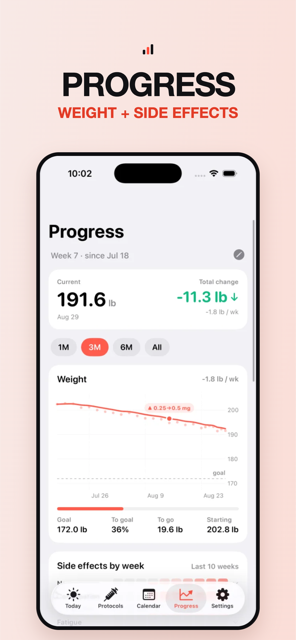
- Read the heat-map in Progress (Pro). The dehydration row sits with vomiting and diarrhea on the same week axis. If it darkens a day after those rows do, you have the acute kind. If it darkens on its own across a quiet week, it is the low-intake kind. The free tier shows the chart blurred.
- Set a check-in reminder (Pro). Settings ▸ Reminders lets you schedule the daily check-in for the evening so the fluid note actually gets written on the days it matters.
- Export before an appointment (Pro). Settings ▸ Export produces a PDF or CSV of doses and check-ins. The export guide covers what is in it.
Related: the side-effects tracking guide, the Ozempic tracker and the Zepbound tracker pages.

Track it in Peppy
123 compounds built in, the units math done for you, body-map site rotation and reminders — private on your iPhone.
 Free · iPhone · no account
Frequently asked
Does Ozempic cause dehydration?
Not directly. Ozempic's label does not list dehydration as an adverse reaction. It warns that most reported cases of acute kidney injury "occurred in patients who experienced gastrointestinal reactions leading to dehydration such as nausea, vomiting, or diarrhea." The gut effects are the cause; dehydration is the consequence to watch for.
What are the signs of GLP-1 dehydration?
The labels do not give a symptom list. Commonly recognised signs are thirst, dark or infrequent urine, dry mouth, headache, lightheadedness when standing, and fatigue. Many people on semaglutide or tirzepatide report they simply forget to drink because the appetite that used to remind them is gone.
Why do GLP-1s make you thirsty?
The labels do not describe thirst as an effect. Many people report it because they eat and drink less overall, lose fluid through vomiting or diarrhea in the escalation weeks, and no longer feel hunger cues that used to come with a drink. Logging fluid alongside symptoms shows whether your thirsty days are also your low-intake days.
Can dehydration on Mounjaro hurt your kidneys?
Mounjaro's label carries an acute kidney injury warning and says the majority of reported events occurred in patients whose gastrointestinal reactions led to dehydration. The label advises monitoring renal function when starting or escalating in patients with kidney impairment who report severe gut reactions. That is a prescriber conversation, not a tracking decision.
When should I call my doctor about dehydration on a GLP-1?
If you cannot keep fluids down, have vomiting or diarrhea that is not settling, are barely urinating, or feel faint on standing. Persistent severe abdominal pain is a separate red flag on every GLP-1 label. Bring your log so the timeline is clear.
Sources
Not medical advice. Peppy is a tracking tool, not medical advice. Dose calculations are mathematical conversions only. Always follow your prescriber's instructions and verify every draw-up yourself.