Diarrhea on GLP-1s: what to track, when it tends to show up, and how to log it
Diarrhea is the second most common GLP-1 side effect on the labels: Wegovy lists it in 30% of trial participants versus 16% on placebo, Zepbound 19–23%, Saxenda 20.9%, Mounjaro 12–17%, Ozempic 8.5–8.8%. The labels say most of it happens during dose escalation. Log severity 1–5 daily with a hydration note, and watch for the dehydration warning signs the labels describe.
GLP-1 diarrhea: what it is and who reports it
GLP-1 diarrhea is loose, urgent or frequent stools in the days around a shot or a dose change. It sits second on most GLP-1 labels, right behind nausea, and it is the reaction the labels tie most directly to a serious warning, because it is the one most likely to leave you dehydrated.
| Label | Diarrhea (drug) | Diarrhea (placebo) |
|---|---|---|
| Wegovy 2.4 mg | 30% | 16% |
| Zepbound 5 / 10 / 15 mg | 19% / 21% / 23% | 8% |
| Saxenda | 20.9% | 9.9% |
| Mounjaro 5 / 10 / 15 mg | 12% / 13% / 17% | 9% |
| Ozempic 0.5 / 1 mg | 8.5% / 8.8% | 1.9% |
The placebo columns matter here. Diarrhea is common in any trial population, so the number to look at is the gap, not the headline. On Mounjaro the gap at 5 mg is three points; on Wegovy it is fourteen. Semaglutide (Ozempic, Wegovy, compounded semaglutide), tirzepatide (Mounjaro, Zepbound, compounded tirzepatide) and liraglutide (Saxenda) all list it. Compounded versions have no label; use the branded figures as the reference.
When it tends to show up
The labels are unusually specific for this one. Mounjaro's and Zepbound's say "the majority of reports of nausea, vomiting, and/or diarrhea occurred during dose escalation and decreased over time". Wegovy's says gastrointestinal reactions "were most frequently reported during dosage escalation". Wegovy's schedule steps every four weeks; Zepbound's starts at 2.5 mg for four weeks and rises in 2.5 mg increments after at least four weeks on a dose. The week after each step is the one to watch.
Within a week, many people report diarrhea as episodic: a bad day or two, often in the first 24–72 hours after a weekly shot, then nothing. Zepbound's label puts median time to peak concentration at 24 hours with a range of 8 to 72 hours, which fits the anecdote without confirming it. Many also report that diarrhea and constipation alternate, sometimes within the same week, which is one reason to track both.
What is worth logging
- Severity, 1–5, daily. Frequency and urgency together. A single loose stool is a 1 or 2; a day you could not leave the house is a 5.
- Hydration in the note. This is the most important note on this page. "Drank plenty", "barely drank", "couldn't keep fluids down". The labels' kidney warning turns on exactly this.
- Days since the shot. Episodic side effects only make sense against the shot day. Log the shot in the same app.
- The dose you were on. Every step-up is a new baseline.
- Weight, but read it carefully. A sudden drop in a diarrhea week is often fluid, not fat. Seeing weight and diarrhea on one timeline stops you from over-reading it.
- Dizziness alongside. Light-headedness in a diarrhea week is a dehydration signal. Peppy tracks dizziness as its own score.
When to contact your prescriber
The labels are direct about diarrhea, and it is worth reading their words rather than a paraphrase.
- Dehydration. The Wegovy, Mounjaro and Zepbound labels say the majority of reported acute kidney injury events "occurred in patients who experienced gastrointestinal adverse reactions leading to dehydration such as nausea, vomiting, or diarrhea". Zepbound's tells prescribers to monitor kidney function in patients reporting reactions "that could lead to volume depletion, especially during dosage initiation and escalation". Saxenda's notes reports of GI reactions "associated with volume depletion and renal impairment".
- "Persistent or severe abdominal pain (sometimes radiating to the back), and which may or may not be accompanied by nausea or vomiting." The pancreatitis warning on every GLP-1 label.
- Diarrhea that will not stop, or comes with a fever or blood. Not on the label as a GLP-1 item, but not something to wait out either.
The labels also list discontinuation for GI reactions: 4.3% on Wegovy, 6.2% on Saxenda, 1.9–4.3% on Zepbound. Delaying an escalation is something the labels say to consider, and something only your prescriber decides.
How to do this in Peppy
- Turn diarrhea on. It is not one of the five GLP-1 defaults, so open Settings ▸ Tracking and toggle Diarrhea. Consider Dehydration and Dizziness in the same list.
- Score it in the daily check-in. Tap the check-in row on the Today tab. Set diarrhea 1–5, then write the hydration note. Add weight if you weighed in; Peppy writes it to Apple Health.
- Log every shot. Tap the dose on the Today tab, choose the site on the body map, save. The time and dose are stored with it, so each check-in has a shot-day offset behind it.
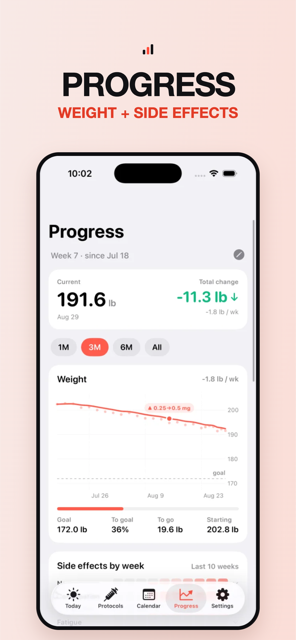
- Read the weekly heat-map in Progress (Pro). The diarrhea and constipation rows sit next to each other with your step-up markers on the same axis. Dark cells after a marker that fade over the next two or three weeks is the pattern the labels describe. On the free tier the chart is blurred.
- Use the Calendar for the day-by-day view. The week strip shows shot days as taken dots; flip through the check-ins and see whether your worst days are days one to three or scattered. If you were late with a shot, see the missed-dose guide for what the labels say.
- Export for your prescriber (Pro). Settings ▸ Export gives a PDF or CSV of doses and check-ins, including the hydration notes. Peppy never sends it anywhere itself.
Related: the side-effects tracking guide, dehydration, and the tirzepatide tracker.

Track it in Peppy
123 compounds built in, the units math done for you, body-map site rotation and reminders — private on your iPhone.
 Free · iPhone · no account
Frequently asked
How common is diarrhea on Wegovy?
Wegovy's label lists diarrhea in 30% of participants versus 16% on placebo. Only nausea (44%) is listed more often. Ozempic's label, at lower doses, lists 8.5% at 0.5 mg and 8.8% at 1 mg versus 1.9%.
How long does GLP-1 diarrhea last?
The labels do not give a duration. Mounjaro's and Zepbound's say the majority of nausea, vomiting and diarrhea occurred during dose escalation and decreased over time; Wegovy's says gastrointestinal reactions were most frequently reported during dosage escalation. Many people report it as episodic rather than constant, which a daily 1–5 log will show.
Does Mounjaro cause diarrhea more than nausea?
At lower doses, slightly. Mounjaro's label lists diarrhea at 12%, 13% and 17% for 5, 10 and 15 mg versus 9% on placebo, and nausea at 12%, 15% and 18% versus 4%. The placebo rate for diarrhea is higher, so the difference from placebo is smaller.
When is diarrhea on a GLP-1 dangerous?
The labels say most reported cases of acute kidney injury occurred in patients who had nausea, vomiting or diarrhea leading to dehydration, and tell prescribers to monitor kidney function in patients reporting reactions that could cause volume depletion. If you cannot keep fluids in, or diarrhea lasts more than a day or two, contact your prescriber.
Can I track diarrhea and constipation in the same log?
Yes, and many people alternate between them. In Peppy both are separate 1–5 scores in the daily check-in, and the Progress tab (Pro) shows them as adjacent rows on a weekly heat-map so you can see them swap.
Sources
Not medical advice. Peppy is a tracking tool, not medical advice. Dose calculations are mathematical conversions only. Always follow your prescriber's instructions and verify every draw-up yourself.