Indigestion on GLP-1s: what the labels call it, when it shows up, and how to track it
Indigestion appears on GLP-1 labels as dyspepsia, and it is common. Wegovy lists it at 9% versus 3% on placebo, Zepbound 9–10% versus 4%, Saxenda 9.6% versus 2.7%, Mounjaro 5–8% versus 3%, and Ozempic 2.7–3.5% versus 1.9%. It usually tracks with meal size and the days after a shot. Score it 1–5 daily with a meal note and line it up against shot days and dose step-ups.
GLP-1 indigestion: what it is and who reports it
GLP-1 indigestion is the heavy, over-full, faintly burning feeling in the upper stomach that arrives after a meal that would not have bothered you before. Semaglutide (Ozempic, Wegovy), tirzepatide (Mounjaro, Zepbound) and liraglutide (Saxenda) all slow gastric emptying, and the labels list the result under the clinical word "dyspepsia". It is one of the more common entries in the tables and one of the least talked about, because it sits between nausea and heartburn and often gets filed under one of them.
| Label | Dyspepsia (drug / placebo) |
|---|---|
| Zepbound 5 / 10 / 15 mg | 9% / 9% / 10% vs 4% |
| Saxenda | 9.6% / 2.7% |
| Wegovy 2.4 mg | 9% / 3% |
| Mounjaro 5 / 10 / 15 mg | 8% / 8% / 5% vs 3% |
| Ozempic 0.5 / 1 mg | 3.5% / 2.7% vs 1.9% |
Nearby terms fill in the picture. Wegovy's label also lists abdominal distension at 7% versus 5%, flatulence at 6% versus 4% and gastritis at 4% versus 1%. Saxenda's lists abdominal distension at 4.5% versus 3%. Reflux is its own line and its own page: see heartburn. Compounded Compounded Semaglutide and Compounded Tirzepatide carry no label; the branded numbers are the reference.
When it tends to show up
The labels do not give dyspepsia its own timeline. Wegovy's says gastrointestinal reactions "were most frequently reported during dosage escalation." Mounjaro's and Zepbound's say the majority of nausea, vomiting and diarrhea "occurred during dose escalation and decreased over time." Indigestion is not called out separately.
What people report is that indigestion is a meal-size problem first and a calendar problem second. The same lunch that was fine on day six after a shot sits like a stone on day two. Many say the first two or three days after each shot are the heavy ones, and that each step-up brings a week or two where every meal feels like too much before it settles again. Wegovy steps every four weeks and Zepbound at least four weeks apart, so those dates belong in the log.
The question a log answers is which matters more for you: the size of the meal, the day of the week, or the dose. Most people find out within three or four weeks of consistent scoring.
What is worth logging
- Severity, 1–5, daily. A 1 is mild fullness after a big meal; a 5 is discomfort after every meal that stops you eating normally. Score the worst point of the day, at the same time each evening.
- Meal size and timing in the note. "Normal dinner, still full at bedtime" or "small lunch, fine" is plenty. You are leaving context, not counting anything.
- Days since your shot. Log the shot in the same app and the offset is automatic.
- The dose you were on. Indigestion at 5 mg and at 10 mg are separate baselines.
- Heartburn, belching and stomach pain alongside. See belching and stomach pain. Which row rises first tells you something.
- Appetite. If your appetite is very suppressed, it is easy to eat little all day and then too much at once. The appetite-control feeling in the check-in catches that.
When to contact your prescriber
Indigestion is not a red-flag reaction on any GLP-1 label. The lines near it are.
- "Persistent or severe abdominal pain (sometimes radiating to the back), and which may or may not be accompanied by nausea or vomiting." This is the pancreatitis warning on every GLP-1 label. Upper-abdominal discomfort that turns into a deep, constant pain is not indigestion.
- Repeated vomiting. The labels tie vomiting-driven dehydration to reports of acute kidney injury. See vomiting.
- Trouble swallowing, or chest pain that is not clearly digestive. Both are reasons to call, and chest pain is an emergency.
- Daily indigestion that is not settling after a step-up. The labels say to consider delaying escalation if a dose is not tolerated. That is your prescriber's decision; the log makes it a short conversation.
How to do this in Peppy
- Turn indigestion on. Heartburn is a GLP-1 default; indigestion is not. Open Settings ▸ Tracking and toggle Indigestion. Belching and Stomach pain sit in the same list.
- Score it in the daily check-in. On the Today tab tap the check-in row. Set indigestion 1–5, write the meal note, rate appetite control in the feelings section, add weight if you weighed in. The check-in counts toward your streak.
- Log shots with the body map. Tap the dose on the Today tab, tap the site on the silhouette, confirm the time. The dose is saved with it, so your titration ladder (Pro) becomes step-up markers on your charts.
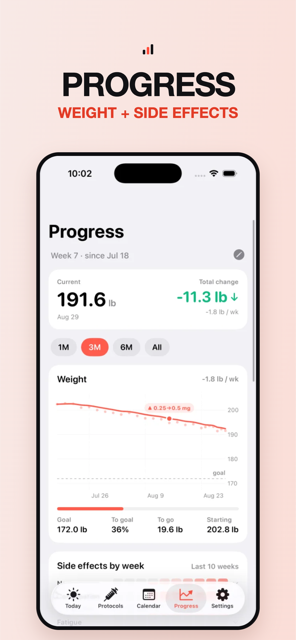
- Read the heat-map in Progress (Pro). The indigestion row sits with heartburn and nausea on one week axis, with step-ups marked. Two rows darkening together after a marker is a different story from indigestion on its own. The free tier shows the chart blurred.
- Use the Calendar for the meal-versus-shot question. The week strip shows shot days. Flip through check-ins and compare day two after a shot with day six. If the notes say "big dinner" on every bad day regardless of shot day, you have your answer.
- Export before an appointment (Pro). Settings ▸ Export produces a PDF or CSV of doses and check-ins. The export guide covers what is in it.
Related: the side-effects tracking guide, the Mounjaro tracker and the Wegovy tracker pages.

Track it in Peppy
123 compounds built in, the units math done for you, body-map site rotation and reminders — private on your iPhone.
 Free · iPhone · no account
Frequently asked
How common is indigestion on GLP-1 medications?
About one in ten on the weight-management labels. Wegovy's prescribing information lists dyspepsia at 9% versus 3% on placebo, Zepbound's at 9%, 9% and 10% by dose versus 4%, and Saxenda's at 9.6% versus 2.7%. Mounjaro lists 8%, 8% and 5% versus 3%, and Ozempic 3.5% and 2.7% versus 1.9%.
What is the difference between GLP-1 indigestion and heartburn?
Dyspepsia is the label word for indigestion: discomfort, fullness or burning in the upper abdomen, often after eating. Heartburn is reflux, the burn behind the breastbone, which the labels list separately as gastroesophageal reflux disease. Many people have both, so Peppy tracks them as two side effects.
Why do GLP-1s cause indigestion?
The labels do not give a mechanism for dyspepsia specifically. GLP-1 medicines slow gastric emptying, and many people report that the heavy, over-full feeling after a normal-sized meal is what indigestion feels like on these drugs. That is why the meal note is the most useful part of a log.
Does GLP-1 indigestion go away?
The labels do not give a duration for dyspepsia. They say gastrointestinal reactions as a group were reported most often during dose escalation, and for Mounjaro and Zepbound that they decreased over time. Many people report it settles as they adjust meal size, which a daily log with a food note will show.
When is indigestion on a GLP-1 a reason to call the doctor?
Every GLP-1 label flags persistent, severe abdominal pain that may radiate to the back, with or without nausea or vomiting, as possible pancreatitis. Indigestion that becomes a deep, constant pain is not indigestion. Daily discomfort that is not settling after a step-up is worth a prescriber conversation with your log in hand.
Sources
Not medical advice. Peppy is a tracking tool, not medical advice. Dose calculations are mathematical conversions only. Always follow your prescriber's instructions and verify every draw-up yourself.