Metallic taste on GLP-1s: what the labels call it, when it shows up, and how to log it
A metallic or altered taste is listed on GLP-1 labels as dysgeusia. Wegovy reports it in 1.7% of patients versus 0.5% on placebo, Zepbound in 0.4% versus none, Mounjaro in 0.1% versus none, and Ozempic groups it with fatigue and dizziness at above 0.4%. Saxenda's label says it was mainly reported in the first 12 weeks, often alongside nausea. Log a 1–5 score with a note on what tasted off and line it up with shot days.
GLP-1 metallic taste: what it is and who reports it
GLP-1 metallic taste is the coin-in-the-mouth flavour that some people notice on semaglutide (Ozempic, Wegovy) or tirzepatide (Mounjaro, Zepbound), or the quieter version where coffee tastes flat and favourite foods taste wrong. The labels file it under one word, dysgeusia, which covers any distorted sense of taste. It is far down the list compared with nausea, and the numbers are small everywhere.
| Label | Dysgeusia (drug / placebo) | How the label reports it |
|---|---|---|
| Wegovy 2.4 mg | 1.7% / 0.5% | separate sentence in adverse reactions |
| Zepbound (pooled) | 0.4% / 0% | separate sentence in adverse reactions |
| Mounjaro (pooled) | 0.1% / 0% | separate sentence in adverse reactions |
| Ozempic | above 0.4%, not itemised | grouped with fatigue and dizziness |
| Saxenda | not tabulated | timing note only, grouped with fatigue and dizziness |
Because the rates are this low, a metallic taste can be easy to dismiss, including by you. But many people who get it say it changes what they want to eat, and on a medication that already flattens appetite that is worth noticing. It overlaps with suppressed appetite and with the way food noise goes quiet, and people do not always separate "I don't want it" from "it tastes wrong". Peppy tracks metallic taste as its own side effect so you can. Compounded Compounded Semaglutide and Compounded Tirzepatide have no label; the branded numbers are your reference.
When it tends to show up
Saxenda's label is the only one that says anything about timing: "events of asthenia, fatigue, malaise, dysgeusia and dizziness were mainly reported within the first 12 weeks of treatment" and "were often co-reported with gastrointestinal events such as nausea, vomiting, and diarrhea". The semaglutide and tirzepatide labels say nothing specific about when taste changes start, only that the gastrointestinal reactions as a group cluster around dose escalation and ease over time.
What people report matches that. Many describe the taste showing up in the first days after a shot, when nausea is also at its worst, and fading toward the end of the week. Many also say it returns for a week or two after each step-up. A smaller group describes a low-level taste change that sits there regardless of the calendar. The log's first job is to tell you which of those you are.
What is worth logging
- Severity, 1–5, daily. Score it at the same time each evening. "Faintly odd" is a 1 or 2. "Could not finish dinner because of it" is a 4.
- What tasted wrong, in the note. "Coffee metallic", "water tastes off", "everything bitter". Patterns by food type are something you will only see in hindsight.
- Days since your shot. Log the shot in the same app and the offset is automatic.
- Fluid intake, roughly. If water tastes wrong, many people drink less without noticing. A "drank little" note matters because of the dehydration warning on every label.
- Nausea alongside. Saxenda's label says the two travel together. Your heat-map will show whether they do for you.
When to contact your prescriber
A metallic taste is not a red-flag reaction on any GLP-1 label. Things around it can be.
- Taste changes plus not drinking. The labels tie fluid loss from gastrointestinal reactions to acute kidney injury. If the taste is stopping you from drinking, that is the problem to raise, not the taste itself.
- Taste changes plus vomiting or dizziness. Same warning, sharper version. See dizziness.
- A taste change that does not settle after the first few months. The labels give no fix. A prescriber can decide whether it is the medication, something else, or whether escalation should wait. The labels say to consider delaying a step-up when a dose is not tolerated; that decision is theirs.
- Eating far less because of it. If your notes say food tastes wrong and you are skipping meals, say so at your next appointment.
How to do this in Peppy
- Turn metallic taste on. It is not one of the five GLP-1 defaults. Open Settings ▸ Tracking and toggle Metallic taste. Nausea is already on; Dehydration and Suppressed appetite are in the same list.
- Score it in the daily check-in. On the Today tab tap the check-in row. Set metallic taste 1–5, write what tasted off, add weight if you weighed in. The check-in counts toward your streak.
- Log shots with the body map. Tap the dose on the Today tab, tap the site on the silhouette, confirm the time. The dose you were on is saved with it, so a titration ladder (Pro) becomes step-up markers on your charts.
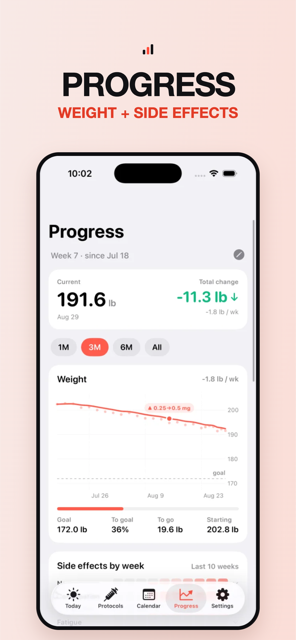
- Read the heat-map in Progress (Pro). Metallic taste and nausea sit as rows on the same week axis with step-ups marked. If both darken in the two days after each shot and fade by day five, that is the shot-day pattern. A row that stays the same shade all week is the other kind. The free tier shows the chart blurred.
- Use the Calendar to check a single week. The week strip shows shot days. Flip through check-ins and compare your day-one score with your day-six score.
- Export before an appointment (Pro). Settings ▸ Export produces a PDF or CSV of doses and check-ins. The export guide covers what is in it.
Related: the side-effects tracking guide, the Ozempic tracker and the Zepbound tracker pages.

Track it in Peppy
123 compounds built in, the units math done for you, body-map site rotation and reminders — private on your iPhone.
 Free · iPhone · no account
Frequently asked
Does Ozempic cause a metallic taste?
Ozempic's label lists dysgeusia, the medical word for altered taste, among other adverse reactions with a frequency above 0.4%, alongside fatigue and dizziness. It does not give a separate percentage. Wegovy, the higher-dose semaglutide, reports dysgeusia in 1.7% of patients versus 0.5% on placebo.
What is dysgeusia on a GLP-1 label?
Dysgeusia means a distorted sense of taste. People describe it as metallic, bitter, or food simply tasting wrong. It is the term the GLP-1 labels use, and it is uncommon on all of them: below 2% on Wegovy and below 0.5% on Zepbound and Mounjaro.
How long does GLP-1 metallic taste last?
Only Saxenda's label speaks to timing, and only in general terms: events of dysgeusia, fatigue, dizziness and malaise were mainly reported within the first 12 weeks and were often reported together with nausea, vomiting or diarrhea. Many people report it settles as the stomach side effects do. A log shows whether yours follows that curve.
Is a metallic taste a sign of something serious?
Not on its own, and the GLP-1 labels do not treat it as a warning sign. A metallic taste together with vomiting, dizziness and very little fluid intake is a different picture, because the labels link dehydration from GI reactions to acute kidney injury. That combination is a reason to call.
Sources
Not medical advice. Peppy is a tracking tool, not medical advice. Dose calculations are mathematical conversions only. Always follow your prescriber's instructions and verify every draw-up yourself.