Migraine on GLP-1s: what the labels actually list, likely triggers, and how to log it
No GLP-1 label lists migraine. Headache is listed: Wegovy 14% versus 10% on placebo at 2.4 mg, Saxenda 13.6% versus 12.6%, and Ozempic's label names headache under postmarketing reports. Mounjaro and Zepbound do not list either. Many people with a migraine history report attacks clustering around shot days, low intake and poor hydration. Log attacks with a 1–5 score, fluids and food in the note, and the shot offset.
GLP-1 migraine: what the labels list and what they do not
GLP-1 migraine is a search a lot of people run, and the honest answer starts with what is missing. Not one of the five branded labels, Ozempic, Wegovy, Mounjaro, Zepbound or Saxenda, lists migraine as an adverse reaction. What they list is headache, and only some of them do that.
| Label | Headache (drug / placebo) | Migraine |
|---|---|---|
| Wegovy 2.4 mg | 14% / 10% | not listed |
| Wegovy 7.2 mg trial | 9% / 8% (2.4 mg) / 7% | not listed |
| Saxenda | 13.6% / 12.6% | not listed |
| Ozempic | postmarketing report, no rate | not listed |
| Mounjaro, Zepbound | not tabulated | not listed |
Read those Wegovy and Saxenda numbers with the placebo column in view. Headache is common on placebo too, and the gap is a few points. That does not mean your migraines are imaginary. It means the trials were not designed to tell a migraine from a tension headache, and that whatever is going on for you probably runs through something the labels do describe rather than through the drug directly. Compounded Compounded Semaglutide and Compounded Tirzepatide have no label; the branded numbers are your reference.
When it tends to show up
Many people with a migraine history report attacks clustering in the day or two after a shot, and in the week or two after a dose step-up. The labels never say that about headache. What they do say is that nausea, vomiting and diarrhea cluster in exactly those windows, and every GLP-1 label carries a warning about dehydration from those reactions, with acute kidney injury as the worst case. Wegovy's label also names dizziness as one of the symptoms of low blood sugar to watch for.
Put that next to what most people with migraine already know about their own triggers: dehydration, skipped meals, disrupted sleep, and caffeine changes. A GLP-1 can deliver all four at once in the first days after a shot. You drink less because water tastes odd or you feel sick, you eat less because appetite is gone, your sleep is off, and the morning coffee gets skipped. The migraine that follows is real. The question a log answers is whether it is shot-day dehydration, a food-gap problem, or something that does not follow the calendar at all.
What is worth logging
- Attacks, not just days. Score migraine 1–5 on the days it happens and leave it blank otherwise. Blank days are data too.
- Fluids and food in the note. "Drank very little", "skipped lunch and dinner", "no coffee today". Three words is enough to make a pattern show up a month later.
- Days since your shot. Log the shot in the same app and the offset is automatic.
- The dose you were on. A migraine month at 0.25 mg and a migraine month at 1 mg are different baselines, and step-up dates are the first thing a prescriber will ask about.
- Sleep, in the feelings row. Peppy tracks sleep 1–5 by default. A bad-sleep score the night before an attack is worth having.
- Nausea and dizziness alongside. See nausea, dizziness and dehydration. If those rows darken with your migraine row, the explanation is probably in the fluids column.
- Ordinary headaches on their own row. Keep headache separate so the migraine row stays clean.
When to contact your prescriber
Migraine is not a red-flag reaction on any GLP-1 label. Some things around it are, and some headaches are emergencies regardless of any medication.
- A sudden, severe headache unlike your usual ones, or a headache with confusion, weakness, trouble speaking or vision loss. Emergency care, not a note in an app.
- Migraines with vomiting that stops you keeping fluids down. The labels tie fluid loss to acute kidney injury. This is the combination to call about the same day.
- Shakiness, sweating, confusion or dizziness with the headache, especially if you also take insulin or a sulfonylurea. The labels warn about low blood sugar in that combination. See low blood sugar.
- A migraine pattern that is new since starting, or clearly worse after a step-up. The labels say to consider delaying escalation if a dose is not tolerated. Your prescriber makes that call; the log turns it into a five-minute conversation.
- Anything you would normally take for a migraine. Whether your usual treatment fits alongside a GLP-1 is a question for the prescriber or pharmacist, not for a tracking app.
How to do this in Peppy
- Turn migraine on. It is not one of the five GLP-1 defaults. Open Settings ▸ Tracking and toggle Migraine. Toggle Headache and Dehydration too if you want the full picture.
- Score it in the daily check-in. On the Today tab tap the check-in row. On attack days set migraine 1–5 and write the fluids-and-food note. On other days leave it blank and log sleep and weight as usual. The check-in counts toward your streak either way.
- Log shots with the body map. Tap the dose on the Today tab, tap the site on the silhouette, confirm the time. The dose is saved with the shot, so a titration ladder (Pro) becomes step-up markers on your charts.
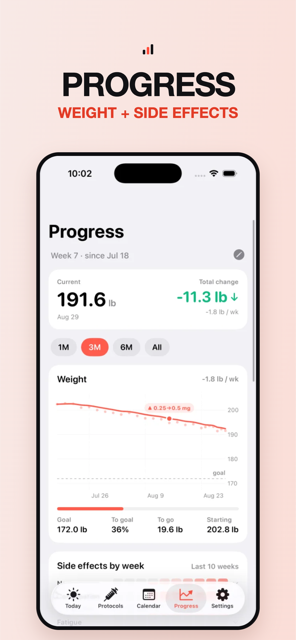
- Read the heat-map in Progress (Pro). Migraine, nausea and dehydration sit as rows on the same week axis. If the migraine row lights up on day one or two after each shot and the dehydration row lights with it, you have a fluids pattern. If it lights on random days, look at the sleep line in the feelings chart instead. The free tier shows the chart blurred.
- Set a check-in reminder (Pro). Settings ▸ Reminders ▸ Check-in nudges you at the same time each evening, which is what keeps blank days honest.
- Export before an appointment (Pro). Settings ▸ Export produces a PDF or CSV of doses and check-ins. The export guide covers what is in it.
Related: the side-effects tracking guide, the Wegovy tracker and the Saxenda tracker pages.

Track it in Peppy
123 compounds built in, the units math done for you, body-map site rotation and reminders — private on your iPhone.
 Free · iPhone · no account
Frequently asked
Can Ozempic or Wegovy cause migraines?
Neither label lists migraine. Wegovy's label lists headache in 14% of patients at 2.4 mg versus 10% on placebo. Ozempic's label lists headache under postmarketing experience without a rate. Whether a GLP-1 turns a headache into a migraine in someone prone to them is not something the labels address.
Does Mounjaro or Zepbound cause headaches?
Neither label tabulates headache or migraine as an adverse reaction. Zepbound's label does list dizziness at 4–5% versus 2% on placebo. Many people on tirzepatide still report headaches, and the usual explanations people give are low fluid intake, eating far less, and the day or two after a shot.
Why do I get a migraine the day after my GLP-1 shot?
The labels do not give a mechanism. The days after a shot are when nausea, vomiting and reduced eating and drinking are at their worst, and every GLP-1 label warns about dehydration from those reactions. For people prone to migraine, dehydration and skipped meals are well-known triggers. A log with fluids and food noted shows whether that is your pattern.
When is a headache on a GLP-1 an emergency?
A sudden, severe headache unlike any you have had, a headache with confusion, weakness, trouble speaking or vision loss, or one after a head injury needs emergency care regardless of any medication. That is not a tracking question. A migraine pattern that is new or worsening since starting a GLP-1 is a prescriber conversation.
Should I track migraine or headache in Peppy?
Track both if you get both. Peppy keeps migraine and headache as separate side effects so a 3-day migraine with aura is not scored on the same row as a dull afternoon headache. If you have a migraine diagnosis, log your usual attacks on the migraine row and use headache for everything else.
Sources
Not medical advice. Peppy is a tracking tool, not medical advice. Dose calculations are mathematical conversions only. Always follow your prescriber's instructions and verify every draw-up yourself.